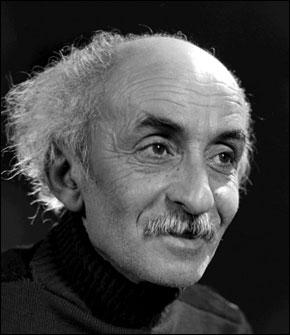
Nima Yoshij (1896 - 1960), his real name is Ali Esfandiyari, the eldest son of Ebrahim Nouri of Yosh (a village near Nour county in Mazandaran province of Iran), was born in November 12 1896. He was a contemporary Tabari (Mazandarani dialect) and Persian poet who started a new movement in Persian poetry called she’r-e no ("new poetry") or sometimes called she’r-e Nimaei (Nimaic poetry).
He grew up in his native village of Yosh and used to help his father with the farm and cattle. His early education in a maktab (traditional school taught by a Mullah) wasn’t satisfactory and later at the age of twelve he was taken to Tehran. Niam was enrolled at St. Louis, a Roman Catholic School.
He began writing poetry when he was a school student. Nezam Vafa (1883-1960), one his teachers, took Nima under his guidance and encouraged him by reading his poems and helping him to improve his poetic abilities. Nezam Vafa was himself a lyric poet who wrote simple love poems in the classical style.
Nima in his speech to the First Congress of Iranian Writers, 1946, in Tehran, Nima Yushij said:
"My first years of life were spent among the shepherds and horse-herders who, in their seasonal movements from one grassland to another, every evening sat round the fire on the Mountainside for long hours. From my childhood years I remember nothing but savage fights, and other things related to a nomadic life, and the simple amusements of those people in an atmosphere of monotony and ignorance. I learned reading and writing from the Akhund [preacher and teacher] of the village where I was born. He used to run after me through the alleyways and, catching me, tied my thin feet to rough, thorny trees and beat me with long canes. He had made a scroll by pasting together some letters which peasants had written to their relatives, and he ordered me to learn the whole scroll by heart."
[From: “Modern Persian Poetry” by: Mahmud Kianush]
Nima was more emphasizing on the length of the line to be determined by the depth of the thought and not by the conventional length of a beyt (verse). Nima portraits his poetry techniques in this quatrain:
With my poetry I have driven the people into a great conflict;
Good and bad, they have fallen in confusion;
I myself am sitting in a corner, watching them:
I have flooded the nest of ants.
[From: “Modern Persian Poetry” by: Mahmud Kianush]
He took poetry out of the court’s rituals and brought it to the streets. Nima added color and flavor to his compositions by using the natural speech of the people.
What made Nima Yoshij a great, powerful guru for the young poets of his time were his innovations in form and style rather than the content of his poetry. He came to the scene of change at a time when all the conservative efforts of the Neo-classicists, Revivalists and others had failed to free Persian poetry from the long decadence which was, to a great extent, the result of the ruling power of prosody over subject matter.
[From: “Modern Persian Poetry” by: Mahmud Kianush]
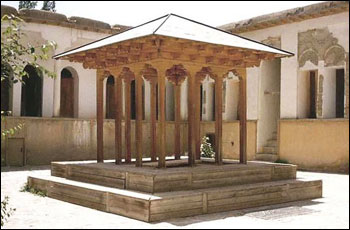
Mausoleum of Nima Yoshij in Yosh (Mazandaran Province)
He died in January 1960 of pneumonia in Shemiran, in the northern part of Tehran and was buried in his native village of Yosh, as he had willed.
My House Is Cloudy
My House is Cloudy
the entire earth is cloudy.
Above the narrow pass, the shattered and desolate and drunken
wind whirls downward.
The entire world is desolated by it
so are my senses!
Oh, piper who has lost the road entranced by the melody of the flute,
where are you?
My house is cloudy but
the cloud is on the verge of weeping.
In the memory of my bright days that slipped through my fingers,
I cast a look upon my sun on the threshold of the ocean
and the entire world is desolated and shattered by the wind
and on the road, the piper continues to play his flute,
in this cloud-filled world
his own path stretching out before him.
Moonlight
The moon beams
the glowworm glows
sleep is seldom ruined, but
worry over this heedless lot
ruins sleep in my tearful eyes.
Dawn stands worried at my side
morning urges me to announce
its arrival to the lot.
alas! a thorn inside,
stops me in my tracks.
A delicate rose stem
which I planted with my hands
and watered with my life
its thorns break inside me.
I fumble about to open a door
uselessly expecting someone to meet
a jumble of walls and doors
crumbles over my head.
The moon beams
the glow-worm glows
blisters marking a distant road
Standing before the village
a single man
knapsack on his back, hand on the knocker, murmurs
"Worry over this lot
ruins sleep in my tearful eyes."
Along the Riverbank
Along the riverbank wanders the old turtle
the day's a sunny day.
The rice-paddy scene is warm.
The old turtle basks in the warm lap of its sun,
sleep at ease
along the riverbank.
Along the riverbank there's only me
tired from the pain of desire,
awaiting my sun.
But my eyes
cannot see it for an instant.
My sun
has hidden its face from me in the distant waters.
For me everything is clear everywhere
in my standing,
in my hurrying,
only my sun is not clear
along the riverbank.
My House Is Cloudy
My House is Cloudy
the entire earth is cloudy.
Above the narrow pass, the shattered and desolate and drunken
wind whirls downward.
The entire world is desolated by it
so are my senses!
Oh, piper who has lost the road entranced by the melody of the flute,
where are you?
My house is cloudy but
the cloud is on the verge of weeping.
In the memory of my bright days that slipped through my fingers,
I cast a look upon my sun on the threshold of the ocean
and the entire world is desolated and shattered by the wind
and on the road, the piper continues to play his flute,
in this cloud-filled world
his own path stretching out before him.
It is Night
A night of deep darkness.
On a branch of the old fig tree
A frog croaks without cease,
Predicting a storm, a deluge,
and I am drowned in fear.
It is night,
And with night the world seems
like a corpse in the grave;
And in fear I say to myself:
"What if torrential rain falls everywhere?"
"What if the rain does not stop
until the earth sinks into the water
like a small boat?"
In this night of awful darkness
Who can say in what state we will be
when dawn breaks?
Will the morning light make
the frightening face of the storm
disappear?
Hey, People
Hey, you over there
who are sitting on the shore, happy and laughing,
someone is dying in the water,
someone is constantly struggling
on this angry, heavy, dark, familiar sea.
When you are drunk
with the thought of getting your hands on your enemy,
when you think in vain
that you've given a hand to a weak person
to produce a better weak person,
when you tighten your belts, when,
when shall I tell you
that someone in the water
is sacrificing in vain?
Hey, you over there
who are sitting pleasantly on the shore,
bread on your tablecloths, clothes on your bodies,
someone is calling you from the water.
He beats the heavy wave with his tired hand,
his mouth agape, eyes torn wide with terror,
he has seen your shadows from afar,
has swallowed water in the dark blue deep,
each moment his impatience grows.
He raises from these waters
a foot, at times,
at times, his head...
Hey you there,
he still has his eyes on this old world from afar,
he's shouting and hopes for help.
Hey you there
who are calmly watching from the shore,
the wave beats on the silent shore, spreads
like a drunk fallen on his bed unconscious,
recedes with a roar, and this call comes from afar again:
Hey, you over there...
And the sound of the wind
more heart-rending by the moment,
and his voice weaker in the sound of the wind;
from waters near and far
again this call is heard:
Hey, you over there...
Snow
Yellow hasn't become red for no reason
the red hasn't cast its colour
upon the wall for no reason.
Morning has come from that side of the Azakoo mountains but
Vazna Mountain is not clear.
The power of the dimly-lit snow works all its chaos
on every window-pane it settles.
Vazna is not clear
from this, I have a heavy heart;
the guest-killing guesthouse's day is dark
every soul jumbled together aimlessly:
some sleepy people
some uncouth people
some simple people.

 |
|