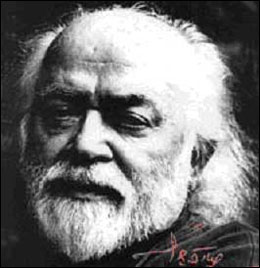
Sadeq Choubak
A writer sympathetic to the miseries of the downtrodden people.
Sadeq Choubak
Sadeq Choubak was born in August 1916, in Bushehr. His father was a well-known merchant of bazaar. He received his early education in Bushehr and Shiraz. Later on he moved to Tehran and attended the Alborz High School. After completing high-school, he was employed as a teacher by the Ministry of Education and sent to Khorramshahr in oil-rich province of Khuzestan, he later joined the National Oil Company.
Choubak was widely considered as the greatest naturalist writer in Persian literature, he has written a large amont of works including novels, short stories, and plays. His collected stories of “Kheymeh Shab Bazi” (Puppet Show) in 1945 and “Antari Ke Lutiyash Murdeh Bud” (The monkey whose master had died) in 1949 did profoundly influence the modern Persian literature. His Bushehri childhood gave Choubak a dimension unusual in Persian writings. He has been accused of taking originality too far.
There was a gap of many years before he came back with a major novel, “Tangsir” in 1963 and two years later in 1965 “Rouze Avval-e Qabr” (The First Day in the Grave) was published. Choubak continued his work and published “Akhareen Sadaqeh” (The Last Alms) and another major novel titled “Sang-e Sabour” (The Patient Stone) in 1966.
In his novel “Tangsir” he details the valorous acts of the fighters of Tangestan (a region near Bushehr province). In the novel, disappointed by social injustice, the protagonist, “Zar Mohammad”, takes justice in his own hands and fights the social wickedness. Zar Mohammad has earns a considerable sum of money and embarks on trading but he is ripped out of his money by the governor. Bitterly despaired by the delay or absence of justice, he takes a gun and kills his enemies one by one. After the killing of the frauds, he is dubbed “Shir Mohammad” (lion-hearted Mohammad) by the villagers. The theme of justice and revenge fills the entire ambience of the novel. Choubak comes across with the message that “Once the law is too slow to serve justice to the ones who deserve it, anarchy will prevail with the consequence that people will decide their own fate and exercise justice in the light of their own definition of the concept.” After long ordeals, Shir Mohammad escapes the grip of the law. Choubak laments the social injustice and the blind ignorance of the law-makers. The quest for justice turns into a messianic mission for the protagonist who comes to be viewed by other villagers as a man who is tasked with liberating them from the tyrannous hands.
Choubak depicts a very brutal world in which people are extremely mortified and they cannot bear the sight of each other in “Sang-e Sabour” (The Patient Stone), which is one of the greatest modern novels in Persian literature.
By and large his popular idioms and proverbs advance the story and form a natural ingredient of dialogue; excess in his work is of a different order.[1]
Choubak has translated some works internationally known writers such as Balzac and Shakespeare into Persian.
Sadeq Choubak died in July 1998, in Berkeley, United States.
Footnotes:
Peter Avery; Bulletin of the School of Oriental and African Studies, University of London, Vol. 48, No. 2, 1985.

 |
|