


The Structure of Power in Iran
SUPREME LEADER
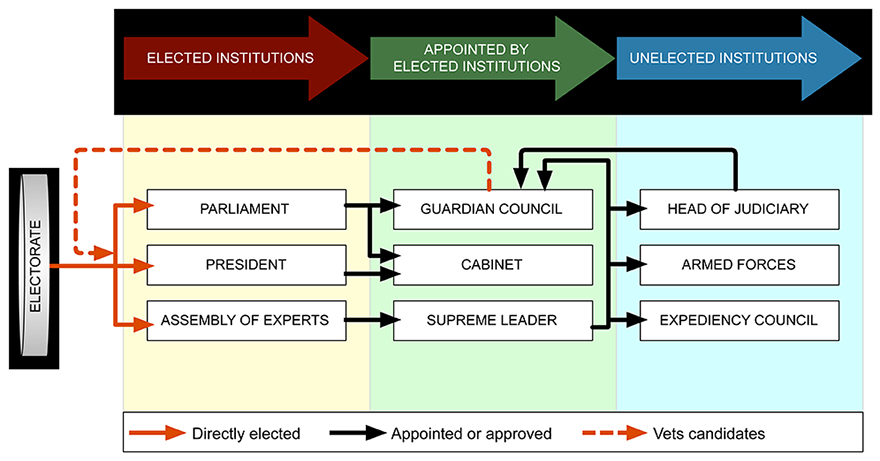
At the top of Iran's power structure is the Supreme Leader, Ayatollah Mojtaba Khamenei, who was elected by the Assembly of Experts following the assassination of his father, Ayatollah Ali Khamenei on February 28, 2026. Ayatollah Ali Khamenei had in turn succeeded Ayatollah Ruhollah Khomeini, the father of the Iranian Revolution, upon Ayatollah Khomeini's death in 1989. Mojtaba Khamenei is the third person to have held the office of Supreme Leader since the founding of the Islamic Republic in 1979.
|
| The chart of Power Structure in Iran |
According to Iran's Constitution, the Supreme Leader is responsible for the delineation and supervision of "the general policies of the Islamic Republic of Iran," which means that he sets the tone and direction of Iran's domestic and foreign policies. The Supreme Leader also is commander-in-chief of the armed forces and controls the Islamic Republic's intelligence and security operations; he alone can declare war or peace. He has the power to appoint and dismiss the leaders of the judiciary, the state radio and television networks, and the supreme commander of the Islamic Revolutionary Guard Corps. He also appoints six of the twelve members of the Council of Guardians, the powerful body that oversees the activities of Parliament and determines which candidates are qualified to run for public office.

|
| Ayatollah Khamenei, Iran's Supreme Leader, 2008 |
The Supreme Leader's sphere of power is extended through his representatives, an estimated 2,000 of whom are sprinkled throughout all sectors of the government and who serve as the Leader's clerical field operatives. In some respects the Supreme Leader's representatives are more powerful than the president's ministers and have the authority to intervene in any matter of state on the Supreme Leader's behalf.
PRESIDENT
The president is the second highest ranking official in Iran. While the president has a high public profile, however, his power is in many ways trimmed back by the constitution, which subordinates the entire executive branch to the Supreme Leader. In fact, Iran is the only state in which the executive branch does not control the armed forces.
The president is responsible for setting the country's economic policies. Though he has nominal rule over the Supreme National Security Council and the Ministry of Intelligence and Security, in practice the Supreme Leader dictates all matters of foreign and domestic security. Eight vice presidents serve under the president, as well as a cabinet of 22 ministers. The Council of Ministers must be confirmed by Parliament.
On 6 July 2024, Dr. Masoud Pezeshkian was elected president after winning the 5 July run-off of the 2024 presidential election with 16.3 million votes (53.7%) to Saeed Jalili's 13.5 million (44.3%). He was formally appointed as the president by the supreme leader of Iran Ayatollah Ali Khamenei on 28 July 2024, and was sworn in before the Iranian parliament on 30 July.
PARLIAMENT (Majles)
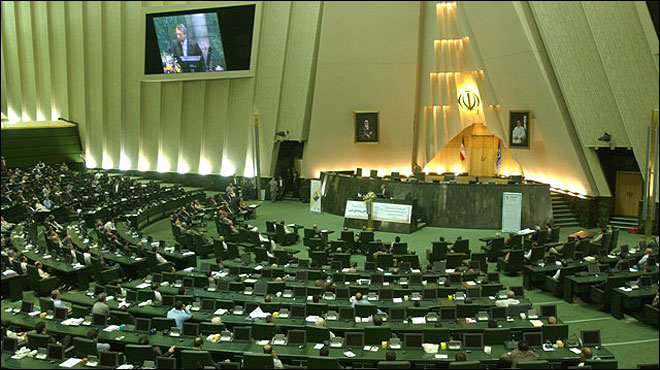
The Iranian Parliament is a unicameral legislative body whose 290 members are publicly elected every four years. It drafts legislation, ratifies international treaties, and approves the country's budget.
|
| A session of Iranian Parliament (Majles) in 2008 |
Parliament is held in check by the Council of Guardians, the influential oversight body that examines all laws passed by Parliament to determine their compatibility with sharia, or Islamic law. At times, the council, half of whose members are appointed by the Supreme Leader, has struck down up to 40 percent of the laws passed by Parliament.
ASSEMBLY OF EXPERTS
The Assembly of Experts, which meets for one week every year, consists of 86 "virtuous and learned" clerics elected by the public to eight-year terms. Like presidential and parliamentary elections, the Council of Guardians determines who can run for a seat in the assembly.
Members of the Assembly of Experts in turn elect the Supreme Leader from within their own ranks and periodically reconfirm him. The assembly has never been known to challenge any of the Supreme Leader's decisions.
COUNCIL OF GUARDIANS
Twelve jurists comprise the Council of Guardians, six of whom are appointed by the Supreme Leader. The head of the judiciary recommends the remaining six, which are officially appointed by Parliament.
The Council of Guardians is vested with the authority to interpret the constitution and determines if the laws passed by Parliament are in line with sharia (Islamic law). This means that the council has effective veto power over Parliament. If it deems that a law passed by Parliament is incompatible with the constitution or sharia, it is referred back to Parliament for revision.
The council also examines presidential and parliamentary candidates to determine their fitness. At times, the council has dramatically filtered candidates. The council of Guardians headed by the former president Ayatollah Ali Akbar Hashemi Rafsanjani.
EXPEDIENCY COUNCIL
In 1988, when stalemates between Parliament and the Council of Guardians proved intractable, Ayatollah Khomeini created the Expediency Council and charged it with mediating disputes between the two bodies. Now, according to the constitution, the Expediency Council serves as an advisory body to the Supreme Leader, making it one of the most powerful governing bodies in the country, at least in name.
The council is currently headed by former President Ayatollah Ali Akbar Hashemi Rafsanjani, and the majority of its 34 members hail from the conservative parties. It has sided, for the most part, with the conservative Council of Guardians in its disputes with Parliament.
JUDICIARY
The judiciary branch of Iran's government is largely controlled by the Supreme Leader, who appoints the head of the judiciary, who in turn appoints the head of the Supreme Court and the chief public prosecutor.
Public courts deal with civil and criminal cases. There are also "revolutionary" courts that try certain categories of offenses, including crimes against national security, narcotics smuggling, and acts that undermine the Islamic Republic. Decisions rendered in revolutionary courts are final and cannot be appealed.
The rulings of the Special Clerical Court, which functions independently of the regular judicial framework and is accountable only to the Supreme Leader, are also final and cannot be appealed. The Special Clerical Court handles crimes allegedly committed by clerics, although it has also taken on cases involving lay people.
NATIONAL SECURITY AND INTELLIGENCE
Iran is the only country whose executive does not control the armed forces. In fact, though the president has nominal rule over the Supreme National Security Council and the Ministry of Intelligence and Security, in practice the Supreme Leader dictates all matters of foreign and domestic security.
-- Supreme National Security Council
Article 176 of Iran's Constitution sets up the Supreme National Security Council, and charges it with "preserving the Islamic Revolution, territorial integrity, and national sovereignty." Its members include: the president; speaker of Parliament; the head of the judiciary; the chief of the combined general staff of the armed forces; the ministers of foreign affairs, the interior, and intelligence; and the commanders of the Islamic Revolutionary Guard Corps and the regular military, among others.
As head of the Supreme National Security Council, the president helps coordinate the Supreme Leader's foreign policy directives.
-- Regular Army
Together with the Islamic Revolutionary Guard Corps (IRGC), the regular army comprises the Islamic Republic's armed forces.
According to Iran's Constitution, the regular army of the Islamic Republic is responsible for guarding the independence and territorial integrity of the country and maintaining order. The army, which falls under the control of the Supreme Leader, must be committed to Islamic ideology
By all measures, the regular army is much better equipped than its other military counterparts in Iran. In the late 1980s, after eight years battling Iraq in a war in which it was largely outgunned, Iran's Parliament announced plans to spend $2 billion a year over five years to purchase weapons. Between 1989 and 2000, the Islamic Republic acquired 526 tanks, 72 combat aircraft, and 13 warships
-- Islamic Revolutionary Guard Corps (IRGC)
The Islamic Revolutionary Guard Corps, or IRGC, which Khomeini created in May 1979, is charged with protecting the revolution and its achievements. It is separate and distinct from the "regular" military, and the rivalry between the two military branches has been everpresent since the founding of the Islamic Republic
Though figures regarding the IRGC's troop strength vary, recent estimates put it at 120,000
In 1982, the IRGC sent troops to Lebanon in support of the Shiite guerrilla group Hezbollah, and it has since become active in supporting Islamic revolutionary movements in other parts of the Muslim world. It is widely assumed that the IRGC is one of the most powerful supporters of Palestinian militant groups in the West Bank, including the Palestinian Islamic Jihad and Hamas movements
To circumvent the weapons embargo that the U.S. imposed after the 1979 embassy takeover in Tehran, the IRGC built its own weapons infrastructure, procuring arms from China, North Korea, and the Soviet Union
-- Ministry of Intelligence and Security (MOIS)
The Ministry of Intelligence and Security (MOIS) is one of the most enigmatic entities operating in the Islamic Republic and reliable information about its structure and reach is hard to come by. What is known is that the Supreme Leader is in control of all matters of defense, security, and foreign policy, and that a special law dictates that the head of the MOIS must be a cleric, which deepens the Supreme Leader's influence
According to the MOIS foundation law, which was passed by Parliament in 1983, the ministry is charged with the "gathering, procurement, analysis, and classification of necessary information inside and outside the country." It is responsible for disclosing conspiracies that sabotage the integrity of the Islamic Republic.