Interview with History: Mohammad Reza Shah Pahlavi
By Oriana Fallaci 1973
Extracted from "Interview with History"
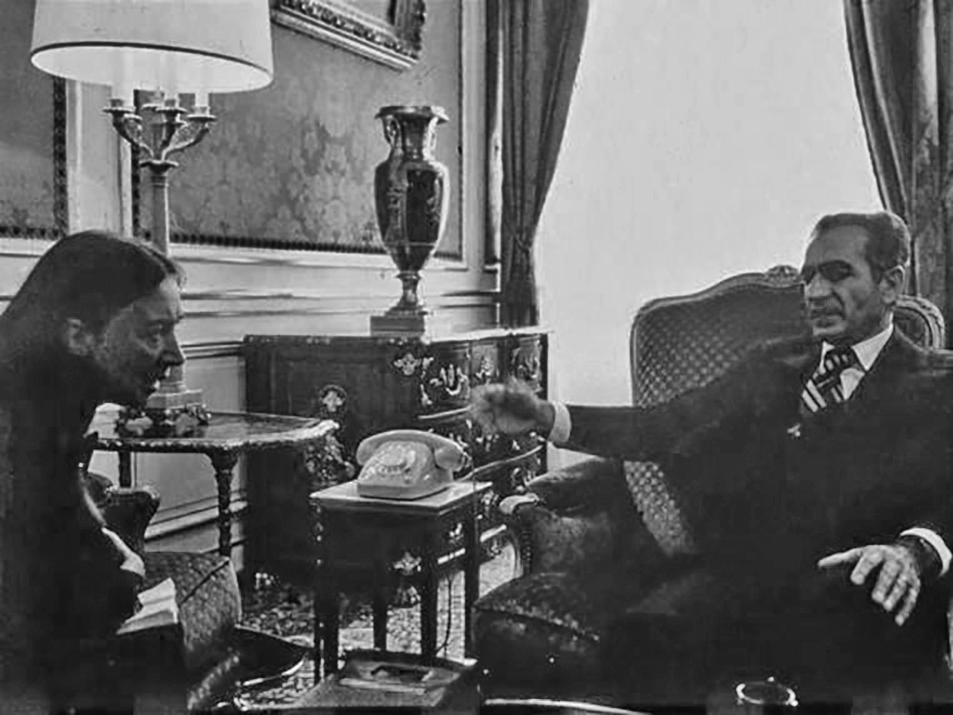
Oriana Fallaci interviews Mohammad Reza Shah Pahlavi, Tehran 1973
The shah was standing and waiting for me in the middle of the magnificent salon that serves him as an office. He made no reply to the little speech by which I thanked him for granting me the interview and in silence, very coldly, extended his right hand. His handshake was stiff. Still more stiffly he asked me to be seated. And everything took place wordlessly, without a smile. His lips were as sealed as a locked door, his eyes as icy as a winter wind. You might have said he was trying to reproach me for something, and I had no idea what it was. Or was he simply inhibited by shyness, by anxiety not to lose his regal tone? Once I was seated, he too sat down: legs together and arms crossed, torso rigid (because of the bulletproof vest, I suppose, that he always wears).
Thus, rigid he stared at me, remote, while I related the incident that had happened at the gate, where his bodyguard had stopped me and almost made me late for the appointment. I finally heard his voice when he replied that he was very sorry but that certain mistakes happened out of an excess of zeal. It was a sad, tired voice. Almost a voiceless voice. His face was also sad and tired. Under his white hair, woolly as a fur cap, only his enormous nose stood out. As for his body, it looked so fragile under the double-breasted gray suit, so thin, that I promptly asked him if he felt well. Very well, he replied, he'd never felt better. The news that his health was in danger was devoid of foundation, and he had wanted to lose weight because he was getting a little too fat.
We had gotten off on the wrong foot, and it took a lot to warm up the atmosphere. Now that I think of it, I succeeded only when I asked if I might light the cigarette that I'd been craving for half an hour. “You could have said so before. I've given up cigarettes myself, but I like the smell of tobacco, the smell of smoke." At this point tea was brought in, served in gold cups with gold teaspoons. But almost everything in the place was gold: the ashtray that you didn’t dare dirty, the box inlaid with emeralds, the knickknacks covered with rubies and sapphires, the corners of the table. And in that absurd and irritating glare of gold, emeralds, rubies, and sapphires, I sat for about two hours, trying to fathom His Majesty. Then, suspecting that I had fathomed nothing, I asked if I might see him again. He agreed, and our second meeting took place four days later.
This time His Majesty was more cordial. To please me, I suppose, he had put on a gaudy Italian necktie, and the conversation flowed easily, if somewhat ruffled on his side by the fear that I might be on his police blacklist. The fear struck him when I had qualified one of my questions by explaining that my book on Vietnam, Nothing, and So Be It, had been banned from the bookstores of Teheran during Nixon’s visit. At this information he had jumped up as though pricked by a knife through his bulletproof vest. His look had become restless, hostile—for God’s sake, was I therefore a dangerous character? Some moments went by before he decided to overcome the dilemma in the only way possible, namely, by relinquishing his excessive composure. Thus, his smile opened up and, amidst smiles, we talked about the authoritarian regime in which he believes, of his relations with the United States and the USSR, of his oil policy. Yes, we talked about everything. Only after I had left did I realize that we had not spoken of the martial crisis that he was said to be going through with Farah Diba. He had only denied to me, with anger and indignation, that he had secretly remarried.
I also realized that I still knew very’ little about him, perhaps less than before; despite three hours of questions and answers, the man remained a mystery. So, it is not easy for me to define his character.
It is, like Bhutto’s, a character in which the most paradoxical conflicts merge to reward you for your pains with an enigma. He believes in prophetic dreams, for example, in visions, in a childish mysticism, and then goes on to discuss oil like an expert (which he is). He governs like an absolute monarch, for example, and then refers to his people in the tone of one who believes in them and loves them, by leading a White Revolution that would seem to be making an effort to combat illiteracy and the feudal system. He considers women as simply graceful ornaments, incapable of thinking like a man, and then strives to give them complete equality of rights and duties. Indeed, in a society where women still wear the veil, he even orders girls to perform military service.
So, who is this Mohammad Reza Pahlavi who for over thirty years has been seated solidly on the most scorching throne in the world? Does he belong to the era of flying carpets or to that of computers? Is he a relic of the Prophet Mohammad or an adjunct of the Abadan oil wells? My suspicion is that he is a highly dangerous megalomaniac, because he combines the worst of the old and the worst of the new, not only to the detriment of his own people but of others as well, Europe in particular. Also, thanks to his foolish visions, he is too firmly convinced of being the reincarnation of Darius and Xerxes, sent to this earth by God to rebuild their lost empire.
In a brilliant short story of political fantasy, the writer Paul Erdman calls him insane and attributes to him the dream of provoking and winning the Third World War. History will tell if this judgment is excessive. But meanwhile the hypotheses formulated by Erdman seem to me entirely possible. Does not Mohammad Reza Pahlavi have at his disposal the most long-lasting oil wells existing in the world and an army that for the moment lacks only the atomic bomb? What is to keep him, with his oil and his army, from occupying, for example, Saudi Arabia and Kuwait, establishing himself on all the shores of the Persian Gulf, supplanting the United States and the Soviet Union, and neutralizing both? Has he not already begun his invasion of the West by trying to buy, among other things, Pan American and Fiat?
We Europeans were naive, indeed superficial, in our underestimation of him, seeing him as a sad and harmless monarch who spent his time agonizing over the lack of an heir. In our superficiality and naivete, we created a figure that did not exist, and relegated him, with his courtships, his engagements, his marriages, divorces, adulteries, and promenades in Rome and Saint-Moritz, to the pages of the scandal sheets. Nearsighted, incapable of seeing beyond this facade, we never took the trouble to put on our eyeglasses and see anything else. For instance, his country's prisons and concentration camps overflowing with political prisoners, the jail cells where they were tortured by medieval means, the courtyards of the barracks where they were shot dozens at a time, under a hellish, ruthless dictatorship where even to utter the word democracy was a mortal sin. We didn't even bother to count his oil wells, which were spreading like wildfire and increasingly fortifying his power at home and abroad. Today, in effect, we are paying the price for our myopia.
I will never forget Reza Pahlavi curtly raising his forefinger, while his eyes glared with hatred, to impress on me that the price of oil would go up, up, up, tenfold. And from the nausea I felt before that gaze and that finger, there remains to me today one small satisfaction: to have made him uncomfortable at the moment in which he understood that he had made a mistake in receiving me. (“You’re not on the blacklist?” “I’m on everybody’s blacklist.”)
Then, the pleasure of discovering that even this Majesty could behave without majesty. When the interview was published, Reza Pahlavi went all out to get me to disavow his remark that the price of oil would go up, up, up, tenfold. Indignantly I refused. He reacted by stating that I had invented it. And then a little later he went ahead and raised the price.
Q01 - Oriana Fallaci: First of all, Majesty, I’d like to talk about yourself and your position as king. There are so few kings left, and I can’t get out of my head something you said in another interview': “If I could do it over again, I’d be a violinist, or a surgeon, or an archaeologist, or a polo player . . . Anything but a king.”
Mohammad Reza Pahlavi: I don’t remember having said those words, but if I did, I was referring to the fact that a king’s job is a big headache. So it often happens that a king gets fed up with being king. It happens to me too. But that doesn’t mean I’d give it up—I have too much belief in what I am and what I'm doing for that. You see . . . when you say there are so few kings left, you’re implying a question to which I can only give one answer. When you don’t have monarchy, you have anarchy or oligarchy or dictatorship. And anyway, monarchy is the only possible way of governing Iran. If I’ve been able to do something, or rather a lot, for Iran, it’s due to the small detail that I happen to be king. To get things done you need power, and to keep power you shouldn’t have to ask permission or advice from anybody. You shouldn’t have to discuss your decisions with anyone and . . . Naturally, I may have made mistakes too. I too am human. But I still believe I have a mission to carry out to the end, and I intend to carry it out to the end without giving up my throne. You can’t foresee the future, of course, but I’m convinced the monarchy in Iran will last longer than your regimes. Or should I say that your regimes won’t last and mine will?
Q02 - Oriana Fallaci: Majesty, how many times have they tried to kill you?
Mohammad Reza Pahlavi: Twice, officially. And then . . . God only knows. But what does it matter? I don’t live with the obsession of being killed. Really. I never think about it. There was a time when I did. Fifteen years ago, for instance. I said to myself, Oh, why go to that place? What if they’ve planned to assassinate me and they kill me? Oh, why take that plane? What if they’ve planted a bomb and it goes off in flight? Not anymore. Now the fear of dying is something I don’t feel. And courage and defiance have nothing to do with it. Such equanimity comes from a kind of fatalism, from blind faith in the fact that nothing can happen to me until the day, I’ve carried out my mission to the end. Yes, I’ll stay alive until such time as I finish what I have to finish. And that day has been set by God, not by those who want to kill me.
Q03 - Oriana Fallaci: Then why are you so sad, Majesty? I may be wrong, but you always have such a sad and worried look.
Mohammad Reza Pahlavi: Maybe you’re right. Maybe I’m a sad man at heart. But my sadness is a mystical one, I think. A sadness that comes from my mystical side. I wouldn’t know how else to explain it, since there’s no reason why I should be sad. I now have everything I wanted as a man and as a king. I really have everything; my life goes forward like a beautiful dream. Nobody in the world should be happier than I, and yet . . .
Q04 - Oriana Fallaci: And yet a cheerful smile on your part is rarer than a shooting star. Don't you ever laugh, Majesty?
Mohammad Reza Pahlavi: Only when something funny happens to me. But it has to be something really very funny. Which doesn't happen often. No, I'm not one of those people who laugh at everything silly, but you must understand that my life has always been so difficult, so exhausting. Just think of what I had to put up with during the first twelve years of my reign. Rome in I953 . . . Mossadegh . . . remember? And I'm not even referring to my personal sufferings—I’m referring to my sufferings as a king. Besides I can't separate the man from the king. Before being a man, I'm a king. A king whose destiny is swayed by a mission to be accomplished. And the rest doesn't count.
Q05 - Oriana Fallaci: My goodness, it must be a great nuisance! I mean, it must be pretty lonely being a king instead of a man.
Mohammad Reza Pahlavi: I don't deny I’m lonely. Deeply so. A king, when he doesn't have to account to anyone for what he says and does, is inevitably very much alone. But I’m not entirely alone because I'm accompanied by a force that others can't see. My mystical force. And then I get messages. Religious messages. I'm very, very religious. I believe in God, and I've always said that if God didn't exist, it would be necessary to invent him. Oh, I feel so sorry for those poor souls who don’t have God. You can’t live without God. I've lived with God ever since the age of five. That is, since God gave me those visions.
Q06 - Oriana Fallaci: Visions, Majesty?
Mohammad Reza Pahlavi: Yes, visions. Apparitions.
Q07 - Oriana Fallaci: Of what? Of whom?
Mohammad Reza Pahlavi: Of prophets. Oh, I'm surprised you don't know about it. Everyone knows I’ve had visions. I even wrote it in my autobiography. As a child I had two visions. One when I was five and one when I was six. The first time, I saw our Imam Zaman**, he who, according to our religion, disappeared to return on the day when he would save the world. I had an accident—I fell against a rock. And he saved me—he placed himself between me and the rock. I know because I saw him. And not in a dream—in reality. Material reality, if you see what I mean. I was the only one who saw him. The person who was with me didn't see him at all. But no one else was supposed to see him except me because . . . Oh, I'm afraid you don't understand me.
Q08 - Oriana Fallaci: Indeed, I don't, Majesty. I don't understand you at all. We had got off to such a good start, and instead now . . . This business of visions, of apparitions . . . It's not clear to me, that’s all.
Mohammad Reza Pahlavi: Because you don't believe. You don’t believe in God, you don't believe me. Many people don't. Even my father didn't believe it. He never believed it, he always laughed about it. Anyway, many people, albeit respectfully, ask if I didn't ever suspect it, was a fantasy. My answer is no. No, because I believe in God, in the fact of having been chosen by God to accomplish a mission. My visions were miracles that saved the country. My reign has saved the country, and it's saved it because God was beside me. I mean, it's not fair for me to take all the credit for myself for the great things that I've done for Iran. Mind you, I could. But I don’t want to, because I know that there was someone else behind me. It was God. Do you see what I mean?
Q09 - Oriana Fallaci: No, Majesty. Because . . . well, did you have these visions only as a child, or have you also had them later as an adult?
Mohammad Reza Pahlavi: I told you, only as a child. Never as an adult—only dreams. At intervals of one or two years. Or even every seven or eight years. For instance, I once had two dreams in the span of fifteen years.
Q10 - Oriana Fallaci: What dreams, Majesty?
Mohammad Reza Pahlavi: Religious dreams. Based on my mysticism. Dreams in which I saw what would happen in two or three months, and that happened just that way in two or three months. But what these dreams were about, I can't tell you. They didn't have to do with me personally; they had to do with domestic problems of the country and so should be considered as state secrets. But perhaps you'd understand better if instead of the word dreams, I used the word presentiments. I believe in presentiments too. Some believe in reincarnation, I believe in presentiments. I have continuous presentiments, as strong as my instinct. Even the day when they shot at me from a distance of six feet, it was my instinct that saved me. Because, instinctively, while the assassin was emptying his revolver at me, I did what in boxing is called shadow' dancing. And a fraction of a second before he aimed at my heart, I moved aside in such a way that the bullet went into my shoulder. A miracle. I also believe in miracles. When you think I’ve been wounded by a good five bullets, one in the face, one in the shoulder, one in the head, two in the body, and that the last one stuck in the barrel because the trigger jammed . . . You have to believe in miracles. I’ve had so many air disasters, and yet I’ve always come out unscathed—thanks to a miracle willed by God and the prophets. I see you’re incredulous.
Q11 - Oriana Fallaci: More than incredulous, I’m confused. I’m confused, Majesty, because . . . Well, because I find myself talking to a person I hadn’t foreseen. I knew nothing about these miracles, these visions . . . I came here to talk about oil, about Iran, about you . . . Even about your marriages, your divorces . . . Not to change the subject, but those divorces must have been quite dramatic. Weren’t they, Majesty?
Mohammad Reza Pahlavi: It’s hard to say because my life has gone forward under the sign of destiny, and when my personal feelings have had to suffer, I’ve always protected myself with the thought that a particular pain was willed by fate. You can’t rebel against destiny when you have a mission to accomplish. And in a king, personal feelings don’t count. A king never cries over himself. He hasn’t the right. A king means first of all duty', and I’ve always had such a strong sense of duty. For instance, when my father told me, “You’re to marry Princess Fawzia of Egypt," it didn’t even occur to me to object or say, “I don’t know’ her." I agreed at once because it was my duty to agree at once. One is either a king, or one isn’t. If one is a king, one must bear all the responsibilities and all the burdens of being a king, without giving in to the regrets or claims or sorrows of ordinary mortals.
Q12 - Oriana Fallaci: Let’s skip the case of Princess Fawzia, Majesty, and take that of Princess Soraya. You chose her yourself as your wife. So, didn’t it hurt you to repudiate her?
Mohammad Reza Pahlavi: Well . . . yes . . . For a while, yes. I can actually say that, for a certain period of time, it was one of the greatest sorrows of my life. But reason prevailed very soon, and I asked myself the following question: What must I do for my country? And the answer was finding another spouse with whom to share my destiny and from whom to ask for an heir to the throne. In other words, my feelings are never focused on private matters but on royal duties. I’ve always trained myself not to be concerned with myself but with my country and my throne. But let's not talk of such things—of my divorces, and so forth. I'm far above, too far above, these matters.
Q13 - Oriana Fallaci: Naturally, Majesty. But there's one thing I can't help asking, since I think it ought to be cleared up. Majesty, is it true you've taken another wife? Ever since the day the German press published the news . . .
Mohammad Reza Pahlavi: Slander, not news, and it was spread around by the French press agency after it had been published by the Palestinian newspaper A/ Mohar for obvious reasons. A stupid, vile, disgusting slander. I'll only tell you that the photograph of the woman who's supposed to be my fourth wife is a photograph of my niece, the daughter of my twin sister. My niece, who besides is married and has a child. Yes, some of the press would do anything to discredit me—it's run by unscrupulous, immoral people. But how can they say that I, I who wanted the law by which it's forbidden to take more than one wife, have got married again and secretly? It’s unthinkable, it's intolerable, it's shameful.
Q14 - Oriana Fallaci: Majesty, but you're a Muslim. Your religion allows you to take another wife without repudiating the Empress Farah Diba.
Mohammad Reza Pahlavi: Yes, of course. According to my religion, I could, so long as the queen gave her consent. And to be honest, one must admit there are cases when . . . For instance, when a wife is sick, or doesn't want to fulfill her wifely duties, thereby causing her husband unhappiness . . . after all! You'd have to be hypocritical or naive to think a husband would tolerate such a thing. In your society, when a circumstance of that kind arises, doesn't a man take a mistress, or more than one? Well, in our society, a man can take another wife. So long as the first wife consents and the court approves. Without those two conditions on which I based my law; however, the new marriage can’t take place. So, I, I myself, should have broken the law by getting married in secret?! And to whom?! My niece?! My sister’s daughter?! Listen, I don’t even want to discuss anything so vulgar. I refuse to talk about it another minute.
Q15 - Oriana Fallaci: All right. Let’s not talk about it anymore. Let’s say you deny everything, Majesty, and . . .
Mohammad Reza Pahlavi: I deny nothing. I don’t even take the trouble to deny it. I don’t even want to be quoted in a denial.
Q16 - Oriana Fallaci: How come? If you don’t deny it, people will go on saying the marriage has taken place.
Mohammad Reza Pahlavi: I’ve already had my embassies issue a denial!
Q17 - Oriana Fallaci: And nobody believed it. So, the denial must come from you, Majesty.
Mohammad Reza Pahlavi: But the act of denying it debases me, offends me, because the matter is of no importance to me. Does it seem right to you that a sovereign of my stature, a sovereign with my problems, should lower himself to deny his marriage with his niece? Disgusting! Disgusting! Does it seem right to you that a king, that an emperor of Persia should waste time talking about such things? Talking about wives, women?
Q18 - Oriana Fallaci: How strange, Majesty, if there’s one monarch who’s always been talked about in relation to women, it’s you. And now I’m beginning to suspect that women have counted for nothing in your life.
Mohammad Reza Pahlavi: Here I’m really afraid you’ve made a correct observation. Because the things that have counted in my life, the things that have left their mark on me, have been quite different. Certainly not my marriages, certainly not women. Women, you know . . . Look, let’s put it this way. I don’t underrate them; they’ve profited more than anyone else from my White Revolution. I’ve fought strenuously so that they’d have equal rights and responsibilities. I’ve even put them in the army, where they get military training for six months and are then sent to the villages to fight the battle against illiteracy. And let’s not forget I’m the son of the man who took away women’s veils in Iran. But I wouldn’t be sincere if I stated I’d been influenced by a single one of them. Nobody can influence me, nobody. Still less a woman. Women are important in a man’s life only if they’re beautiful and charming and keep their femininity and . . . This business of feminism, for instance. What do these feminists want? What do you want? You say equality. Oh! I don't want to seem rude, but . . . You're equal in the eyes of the law but not, excuse my saying so, in ability.
Q19 - Oriana Fallaci: No, Majesty?
Mohammad Reza Pahlavi: No. You've never produced a Michelangelo or a Bach. You’ve never even produced a great chef. And if you talk to me about opportunity, all I can say is, are you joking? Have you ever lacked the opportunity to give history a great chef? You’ve produced nothing great, nothing! Tell me, how many women capable of governing have you met in the course of your interviews?
Q20 - Oriana Fallaci: At least two, Majesty. Golda Meir and Indira Gandhi.
Mohammad Reza Pahlavi: Who knows? . . . All I can say is that women, when they govern, are much harsher than men. Much crueler. Much more bloodthirsty. I’m citing facts, not opinions. You're heartless when you have power. Think of Catherine de Medicis, Catherine of Russia, Elizabeth I of England. Not to mention your Lucrezia Borgia, with her poisons and intrigues. You're schemers, you're evil. All of you.
Q21 - Oriana Fallaci: I'm surprised, Majesty, because it’s you who appointed the Empress Farah Diba regent should the crown prince accede to the throne while still a minor.
Mohammad Reza Pahlavi: Hm . . . well . . . Yes, if my son should become king before the required age, Queen Farah Diba would become regent. But there'd also be a council with which she’d have to consult. I, on the other hand, have no obligation to consult with anyone, and I don't consult with anyone. See the difference?
Q22 - Oriana Fallaci: I see it. But the fact remains that your wife would be regent. And if you took this decision, Majesty, it means you think she’s capable of governing.
Mohammad Reza Pahlavi: Hm. ... In any case, that’s what I thought when I took the decision. And . . . we're not here just to talk about this, are we?
Q23 - Oriana Fallaci: Certainly not. Besides I haven’t even begun to ask you the things that interest me most, Majesty. For example, when I try to talk about you, here in Teheran, people lock themselves in a fearful silence. They don’t even dare pronounce your name, Majesty. Why is that?
Mohammad Reza Pahlavi: Out of an excess of respect, I suppose. With me, in fact, they don’t behave like that at all. When I returned from America, I drove through the city in an open car, and from the airport to the palace I was wildly applauded, by at least a million people overcome with enthusiasm. They cheered, they shouted patriotic slogans, they were by no means locked in silence as you say. Nothing has changed since the day I became king and the people lifted my car on their shoulders and carried it for three miles. Yes, it was three miles from the house where I lived to the building where I was to take my oath to the Constitution. And I was riding in that car. After a few yards the people lifted the car like a sedan chair and carried it on their shoulders for a good three miles. What was your question supposed to mean? That they’re all against me?
Q24 - Oriana Fallaci: God forbid, Majesty. I meant only what I said. Here in Teheran people are so afraid of you they don’t even dare pronounce your name.
Mohammad Reza Pahlavi: And why should they talk about me to a foreigner? I don’t see what you’re referring to.
Q25 - Oriana Fallaci: I’m referring to the fact, Majesty, that many people consider you a dictator.
Mohammad Reza Pahlavi: That’s what they write in Le Monde. And what do I care? I work for my people. I don’t work for Le Monde.
Q26 - Oriana Fallaci: Yes, yes, but would you deny you’re a very authoritarian king?
Mohammad Reza Pahlavi: No, I wouldn’t deny it, because in a certain sense I am. But look, to carry through reforms, one can’t help but be authoritarian. Especially when the reforms take place in a country like Iran, where only twenty-five percent of the inhabitants know how to read and write. You mustn’t forget that illiteracy is drastic here—it’ll take at least ten years to eliminate it. And I don’t say to eliminate it for everyone—I say to eliminate it for those who today are under the age of fifty. Believe me, when three-quarters of a nation doesn’t know how to read or write, you can provide for reforms only by the strictest authoritarianism—otherwise you get nowhere. If I hadn’t been harsh, I wouldn’t even have been able to carry out agrarian reform and my whole reform program would have been stalemated. Once that had happened, the extreme left would have liquidated the extreme right within a few hours, and it’s not only the White Revolution that would have been finished. I had to do what I did. For instance, order my troops to open fire on anyone opposing the distribution of land. So, to say that in Iran there’s no democracy . . .
Q27 - Oriana Fallaci: Is there, Majesty?
Mohammad Reza Pahlavi: I assure you, there is. I assure you that in many ways Iran is more democratic than your countries in Europe. Aside from the fact that the peasants own their land, that the workers participate in the management of the factories, that the large industrial complexes are owned by the state instead of private individuals, you should know that elections here begin in the villages and take place at local, municipal, and provincial levels. In Parliament, of course, there are only two parties. But they’re the ones that accept the twelve points of my White Revolution, and how many parties ought to represent the ideology of my White Revolution? Besides those are the only two that are able to get enough votes—the minorities are so negligible, so ridiculous in size that they wouldn’t even be able to elect a deputy'. And be that as it may, I don’t want certain minorities to elect any deputies. Just as I won’t allow the Communist party'. The communists are outlawed in Iran. They only want to destroy, destroy, destroy, and they swear allegiance to others instead of to their country and their king. They’re traitors, and I’d be crazy to let them exist.
Q28 - Oriana Fallaci: Maybe I explained myself badly, Majesty. I meant democracy as we understand it in the West, namely, a regime that permits anyone to think as he likes and is based on a parliament where even minorities are represented . . .
Mohammad Reza Pahlavi: But I don’t want that kind of democracy! Don’t you understand? I wouldn’t know what to do with such a democracy! It’s all yours, you can have it! Your wonderful democracy! You’ll see, in a few years, where your wonderful democracy leads.
Q29 - Oriana Fallaci: Well, maybe it’s a little chaotic. But it’s the only thing possible if you respect man and his freedom of thought.
Mohammad Reza Pahlavi: Freedom of thought, freedom of thought! Democracy, democracy! With five-year-old children going on strike and parading through the streets. That’s democracy? That’s freedom?
Q30 - Oriana Fallaci: Yes, Majesty.
Mohammad Reza Pahlavi: Well, not to me. And let me add: how much studying have you done in the last few years in your universities? And if you go on not studying in your universities, how will you be able to keep up with the needs of technology? Won’t you become servants of the Americans thanks to your lack of preparation, won’t you become third- or even fourth-rate countries? Democracy freedom democracy! But what do these words mean?
Q31 - Oriana Fallaci: Excuse me if I take the liberty of saying it, Majesty. But in my opinion, they mean, for example, not removing certain books from bookstores when Nixon comes to Teheran. I know that my book on Vietnam was removed from the bookstores when Nixon came here and put back only after he’d left.
Mohammad Reza Pahlavi: What?
Q32 - Oriana Fallaci: Yes, yes.
Mohammad Reza Pahlavi: But you’re not on the blacklist, are you?
Q33 - Oriana Fallaci: Here in Teheran? I don’t know. It could be. I’m on everybody’s blacklist.
Mohammad Reza Pahlavi: Hm . . . And here I’m receiving you in the palace, and you’re here sitting next to me . . .
Q34 - Oriana Fallaci: Which is very kind of you, Majesty'.
Mohammad Reza Pahlavi: Hm . . . It certainly shows we have democracy and freedom here . . .
Q35 - Oriana Fallaci: It certainly does. But I’d like to ask you something, Majesty. I’d like to ask you: if I were an Iranian instead of an Italian, and lived here and thought as I do and wrote as I do, I mean if I were to criticize you, would you throw me in jail?
Mohammad Reza Pahlavi: Probably. If what you thought and wrote went counter to our laws, you’d be put on trial.
Q36 - Oriana Fallaci: Really? And sentenced too?
Mohammad Reza Pahlavi: I think so. Naturally. But, between ourselves, I don’t think you'd find it easy to criticize or attack me in Iran. What would you criticize or attack me for? For my foreign policy? For my oil policy? For having distributed land to the peasants? For allowing workers to share in profits up to twenty percent and to be able to buy stock up to forty-nine percent? For fighting illiteracy and disease? For having brought progress to a country where there was little or none?
Q37 - Oriana Fallaci: No, no. Not for that, Majesty. I’d attack you . . . let's see. I know for the repression carried out against students and intellectuals in Iran, for example. I've been told the prisons are so full that new arrests have to be put in army camps. Is that true? But how many political prisoners are there in Iran today?
Mohammad Reza Pahlavi: I don't know exactly. It depends on what you mean by the expression political prisoners. If you're speaking of the communists, for instance, I don’t consider them political prisoners because it's forbidden by law to be a communist. Therefore, a communist to me is not a political prisoner but a common criminal. If then you mean those whose actions result in the death of old people, women, innocent children, it's all the more obvious that I don't even consider them political prisoners. To them, I show no mercy. Oh, I've always pardoned those who've tried to kill me, but I've never had the slightest pity for those criminals you call guerrillas or for traitors to the country. They’re the sort of people who are capable of killing my son if only to plot against public safety. They’re people to be eliminated.
Q38 - Oriana Fallaci: In fact, you have them shot, don't you?
Mohammad Reza Pahlavi: Those who have killed people, of course. They’re shot. But not because they’re communists—because they're terrorists. Communists are simply sentenced to prison, for terms that may vary from a few to several years. Oh, I can imagine what you think about the death penalty, and so forth. But, you see, certain opinions depend on the type of education one has had, on culture, on climate, and you shouldn't take it for granted that what goes for one country goes for them all. Take an apple seed and plant it in Teheran, then take another seed from the same apple and plant it in Rome—the tree that grows in Teheran will never be the same as the tree that grows in Rome. Here it's right and necessary to shoot certain people. Pietism is absurd here.
Q39 - Oriana Fallaci: While listening to you, I was wondering something, Majesty. I was wondering what you think of the death of Allende.
Mohammad Reza Pahlavi: Here's what I think. I think his death teaches us a lesson; you must be one thing or the other, be on one side or the other, if you want to accomplish something and win. Middle-of-the-road compromises aren’t possible. In other words, either you’re a revolutionary or else you insist on law and order—you can’t be a law-and-order revolutionary. Much less a tolerant one. And if Allende wanted to rule in accordance with his Marxist ideas, why didn’t he organize himself better? When Castro came to power, he killed at least ten thousand people, while all of you said, “Bravo, bravo, bravo!’’ Well, in a certain sense he deserved the bravos since he’s still in power. But then so am I. And I plan on staying there by showing that with force you can do a lot of things, and I’ll even prove that your socialism is finished. Old, obsolete, finished. People were talking about socialism a hundred years ago; they were writing about it a hundred years ago. Today it no longer goes with modern technology. I achieve more than the Swedes, and in fact can’t you see that even in Sweden the socialists are losing ground? Ah! Swedish socialism! . . . It hasn’t even nationalized forests and water. I have.
Q40 - Oriana Fallaci: Again, Majesty, I don’t understand. Are you telling me that in a certain sense you’re a socialist, and that your socialism is more modern and advanced than the Scandinavian kind?
Mohammad Reza Pahlavi: Of course. Because that socialism means a system of social security for those who don’t work and nevertheless receive a salary at the end of the month like those who do work. The socialism of my White Revolution, on the other hand, is an incentive to work. It’s a new, original socialism, and . . . believe me, in Iran we’re much more advanced than you and really have nothing to learn from you. But these are things you Europeans will never write—the international press is so infiltrated by leftists, by the so-called left. Ah, this left! It’s even corrupted the clergy. Even the priests! By now even they’re turning into elements whose purpose is only to destroy, destroy, destroy. And even in Latin American countries, even in Spain! It seems incredible. They abuse their own church.
Their own church! They talk about injustice, about equality. . . . Ah, this left! You’ll see, you’ll see where it’ll bring you.
Q41 - Oriana Fallaci: Let’s get back to you, Majesty. So intransigent, so harsh, maybe even ruthless, behind that sad face. In the end so similar to your father. I wonder to what extent you’ve been influenced by your father.
Mohammad Reza Pahlavi: None at all. Not even my father could influence me. I’ve told you, nobody can influence me! Yes, I was fond of my father. Yes, I admired him. But that’s all. I never tried to copy him, to imitate him. Nor would it have been possible, even if I’d wanted to. As personalities we were too different, and even the historical circumstances in which we found ourselves were too different. My father started from nothing. When he came to power, the country had nothing. Nor did he even have the problems we have today on the frontiers, especially with the Russians. And my father could afford to have good neighborly relations with everyone. The only basic threat was represented by the British, who in 1907 had divided Iran between themselves and the Russians, and wanted Iran to constitute a kind of no man’s land between Russia and their empire in India. But later the British gave up this plan, and things became fairly easy for my father.
I, instead . . . I didn’t start from nothing; I found a throne. But no sooner was I on the throne than I found myself having to lead a country occupied by foreigners. And I was only twenty-one. That’s not much, twenty-one, not much. Besides, I didn’t only have to keep the foreigners in check and nothing else. I had to face a sixth column on the extreme right and extreme left—to exert greater influence on us, the foreigners had created the extreme right and extreme left . . . No, it wasn’t easy for me. Maybe it was more difficult for me than for my father. Without counting the period of the cold war, which lasted up until a few years ago.
Q42 - Oriana Fallaci: Majesty, you just mentioned the problems you have on the frontiers. Which is your worst neighbor today?
Mohammad Reza Pahlavi: You can never tell, since you never know who your worst neighbor is. But I’d be inclined to say that at the moment it’s Iraq.
Q43 - Oriana Fallaci: I’m surprised, Majesty, that you should cite Iraq as your worst neighbor. I was expecting you to say the Soviet Union.
Mohammad Reza Pahlavi: The Soviet Union . . . With the Soviet Union we have good diplomatic and trade relations. With the Soviet Union we have a gas pipeline. I mean we sell gas to the Soviet Union. Technicians come to us from the Soviet Union. And the cold war is over. But the question with the Soviet Union will always be the same, and in negotiating with the Russians, Iran must always keep in mind the chief dilemma: to become communist or not? No one can be so crazy or naive as to deny Russian imperialism. And though Russia has always had an imperialistic policy, the fact remains it's much more dangerous today because it’s linked to communist dogma. I mean to say it’s easier to face countries that are only imperialist than countries that are both imperialist and communist. There’s what I call the USSR’s pincer movement. There’s their dream of reaching the Indian Ocean by passing through the Persian Gulf. And Iran is the last bastion for the defense of our civilization, of what we consider decent. If they were to try to attack this bastion, our survival would depend solely on our capacity and will to resist. So, the problem of resisting comes up from now on.
Q44 - Oriana Fallaci: And Iran today is pretty strong militarily, isn’t it?
Mohammad Reza Pahlavi: Very strong, but not strong enough to be able to resist the Russians in case of attack. That’s obvious. For instance, I don’t have the atomic bomb. But I feel strong enough to resist should the Third World War break out. Yes, I said Third World War. Many think the Third World War can only break out over the Mediterranean, but I say it can break out much more easily over Iran. Oh, much more easily! It’s we, in fact, who control the world’s energy resources. To reach the rest of the world, oil doesn’t go through the Mediterranean, it goes through the Persian Gulf and the Indian Ocean. So, if the Soviet Union were to attack us, we’d resist. And we’d probably be overcome, and then the noncommunist countries could hardly sit there with their hands folded. And they’d intervene. And it would be the Third World War. Obviously. The noncommunist world couldn’t accept the disappearance of Iran, because it knows that to lose Iran would mean to lose everything. Have I made myself clear?
Q45 - Oriana Fallaci: Perfectly clear. And horribly. Because you talk of the Third World War like something that’s going to happen in the near future, Majesty.
Mohammad Reza Pahlavi: I speak of it as something possible with the hope that it won't happen. As a possibility for the near future, I see instead a small war with one of our neighbors. After all, we have nothing but enemies on our frontiers. It's not only Iraq that's giving us trouble.
Q46 - Oriana Fallaci: And your great friend, Majesty, I mean the United States, is geographically remote.
Mohammad Reza Pahlavi: If you're asking me who I consider our best friend, the answer is the United States among others. Because the United States isn't our only friend—plenty of countries show us friendship and believe in us, in the importance of Iran. But the United States understands us better for the simple reason that it has so many interests here. Economic and therefore direct interests, political and therefore indirect interests . . . I've just said that Iran is the key, or one of the keys, to the world. I need only add that the United States cannot shut itself up within the borders of its country, it cannot go back to the Monroe Doctrine. It's obliged to honor its responsibilities toward the world and thus to be concerned with us. And that does nothing to detract from our independence, because everyone knows that our friendship with the United States doesn't make us slaves of the United States. The decisions are made here, in Teheran. Not elsewhere. Not in Washington, for example. I get along with Nixon as I've got along with other presidents of the United States, but I can continue to get along with him only if I'm sure that he's treating me as a friend. In fact, as a friend who within a few years will represent a world power.
Q47 - Oriana Fallaci: The United States is also good friends with Israel, and you've expressed yourself lately toward Jerusalem in very harsh terms. Less harshly toward the Arabs, on the other hand, with whom it seems you want to improve relations.
Mohammad Reza Pahlavi: We base our policy on fundamental principles, and we cannot accept the idea that a country, in this case Israel, should annex territory through the use of arms. We can't because if this principle is applied to the Arabs, it may one day be applied to us. You'll tell me it’s always been like this that frontiers have always changed as a result of the use of arms and war. I agree, but that's no reason to recognize this fact as a valid principle. Besides everyone knows that Iran has accepted the UN resolution of I967, and if the Arabs lose faith in the UN, how are you to persuade them that they’ve been defeated? What’s to keep them from taking their revenge? Even from using the oil weapon? Oil will go to their heads. Besides it’s already going to their heads.
Q48 - Oriana Fallaci: Majesty, you side with the Arabs but sell oil to the Israelis.
Mohammad Reza Pahlavi: Oil is sold by the oil companies, and so to anyone. Our oil goes everywhere—why shouldn’t it go to Israel? And why should I care if it goes to Israel? It goes where it goes. And as for our personal relations with Israel, as you know, we have no embassy in Jerusalem, but we have Israeli technicians in Iran. We’re Muslims but not Arabs. And in foreign policy we take a very independent position.
Q49 - Oriana Fallaci: Does such a position foresee the day when Iran and Israel will establish normal diplomatic relations?
Mohammad Reza Pahlavi: No. Or rather, not until the question of the withdrawal of Israeli troops from the occupied territories has been resolved. And as for the possibilities of this question being resolved, I can only say that the Israelis have no choice—if they want to live in peace with the Arabs. It’s not only the Arabs who spend enormous sums of money on war materials, it’s also the Israelis. And I don’t see how either the Arabs or Israelis can keep it up for long. Besides, new phenomena are beginning to occur in Israel—strikes, for example. How long will Israel go on nursing the terrible and fantastic spirit that inspired it at the time of its formation? I’m thinking especially of the new generations in Israel, and of the Israelis who come from Eastern Europe to find themselves treated differently from the others.
Q50 - Oriana Fallaci: Majesty, you said something a while ago that struck me. You said Iran would soon represent a world power. Were you perhaps referring to the forecasts of those economists who say that within thirty-six years Iran should be the richest country in the world?
Mohammad Reza Pahlavi: To say it will become the richest country in the world is perhaps going too far. But to say it will rank among the five greatest and most powerful countries in the world isn’t going too far at all. Thus, Iran will find itself at the same level as the United States, the Soviet Union, Japan, and France. I don’t mention China because China isn’t a rich country, nor can it become one if within twenty-five years it reaches the 1,400,000,000 inhabitants that have been predicted. We, on the other hand, in twenty-five years will be 60,000,000 at most. Oh, yes, we can expect great wealth, and great strength, whatever the communists may say. It's no coincidence that I’m getting ready to launch a birth control program. And here’s the point I want to make you can’t separate the economy from other things, and once a country is rich economically, it becomes rich in every sense. It becomes powerful on an international level. Besides, when speaking of the economy, I’m not only referring to oil—I’m referring to a balanced economy that includes every kind of production, from the industrial to the agricultural, from handicrafts to electronics. We should have made the transition from carpets to computers—the result, instead, is that we’ve kept the carpets while adding the computers. We still make carpets by hand, but we also make them by machine. What’s more, we make wall-to-wall carpeting. Every year we double our national production. Anyway, there are so many signs that we’ll become a world power. Ten years ago, for instance, when my White Revolution began, there were only 1,000,000 students in the schools. Today there are 3,100,000, and in ten years there’ll be 5,000,000 or 6,000,000.
Q51 - Oriana Fallaci: You’ve just said that you weren’t only referring to oil, Majesty, but we all know that it’s thanks to oil that you have computers, and that it’s thanks to oil that you turn out machine-made rugs, and that tomorrow’s riches are also coming to you thanks to oil. Shall we finally talk about the policy you’ve adopted concerning oil and with regard to the West?
Mohammad Reza Pahlavi: It’s simple. I have this oil and I can’t drink it. But I know I can exploit it to the utmost without blackmailing the rest of the world and even by trying to keep it from being used to blackmail the rest of the world. Therefore, I’ve chosen a policy of guaranteeing its sale to everyone without distinction. It hasn’t been a difficult choice—I’ve never thought of aligning myself with the Arab countries that were threatening to blackmail the West. I’ve already said that my country is independent, and everyone knows that my country is Muslim but not Arab, therefore what I do is not to suit the Arabs but to help Iran. Besides Iran needs money, and with oil you can make a lot of money. Oh, that’s the whole difference between me and the Arabs. Because the countries that say “we won’t sell any more oil to the West” don’t know what to do with their money and so they don’t worry about the future. Often, they have a population of only six or seven hundred thousand inhabitants and so much money in the bank that they could live for three or four years without pumping or selling a drop of oil. Not I. I have these thirty-one and a half million inhabitants, and an economy to develop, a program of reforms to complete. Therefore, I need money. I know what to do with money, and I can’t afford not to pump oil. I can’t afford not to sell it to anyone.
Q52 - Oriana Fallaci: Meanwhile Qaddafi calls you a traitor.
Mohammad Reza Pahlavi: Traitor?!? Me a traitor, when I’ve taken the whole business into my hands and already dispose of fifty-one percent of the production that formerly belonged exclusively to foreign oil companies? I wasn’t aware Mr. Qaddafi had addressed such an insult to me and . . . Look, I can’t take this Mr. Qaddafi at all seriously. I can only wish him success in serving his country as I succeed in serving mine, I can only remind him that he shouldn’t scream so much—the Libyan oil reserves will be exhausted in ten years’ time. My oil, on the other hand, will last at least thirty or forty years. And maybe fifty, sixty. It depends on whether or not we discover new deposits, and it’s very, very likely that new deposits will be discovered. But even if that shouldn’t happen, we’ll manage extremely well just the same. Our production is visibly increasing—in 1976 we’ll be extracting as much as eight million barrels a day. Eight million barrels are a lot, quite a lot.
Q53 - Oriana Fallaci: In any case, you’ve made quite a few enemies, Majesty.
Mohammad Reza Pahlavi: That I still can’t say. In fact, the OPEC hasn’t yet decided not to sell oil to the West, and it may very well be that my decision not to blackmail the West will induce the Arabs to follow my example. If not all the Arabs, at least some of them. If not right away, in a short time. Some countries aren’t independent like Iran, they haven’t the experts Iran has, and they don’t have the people behind them as I do. I can dictate my own terms. They still can’t. It’s not easy to reach a point where you can sell your oil directly and be free of the oil companies that have had a monopoly for decades and decades. And if even the Arab countries were to follow my decision . . . Oh, it would be so much simpler, and safer too, if the Western countries were exclusively buyers and we direct sellers! There’d be no resentment, blackmail, rancor, hostility . . . Yes, it may very well be that I'm setting a good example, and in any case, I’m going ahead with it. Our doors are wide open to anyone who wants to sign a contract with us, and many have already offered to do so. British, Americans, Japanese, Dutch, Germans. They were so shy in the beginning. But now they're becoming ever more daring.
Q54 - Oriana Fallaci: And the Italians?
Mohammad Reza Pahlavi: We're not selling much oil to the Italians at the moment, but we may reach an important agreement with ENI* and I think we're on the way to doing so. Yes, we may become excellent partners with ENI, and anyway our relations with the Italians have always been good. Ever since the time of Mattei. Wasn't the agreement I signed with Mattei in 1957 my first success in breaking the old system of exploitation by foreign oil companies? Oh, I don't know what others say about Mattei, but I know I’ll never be able to be objective in talking about him. I liked him too much. He was a very decent fellow, and a man capable of reading the future, a really exceptional personality.
Q55 - Oriana Fallaci: As a matter of fact, they killed him.
Mohammad Reza Pahlavi: Probably. But he shouldn't have been flying in that bad weather. The fog in Milan gets very thick in winter, and oil can really become a curse. But maybe it wasn't just the bad weather. And anyway, it was a great shame. For us too. Well, I'm not saying that Mattei’s death brought about a setback in our relations with ENI. No, no, since we're about to conclude a large deal. Mattei couldn't have done any better, since what we're about to do now is really the maximum. Still if Mattei had lived, we'd have reached this agreement years ago.
Q56 - Oriana Fallaci: I’d like to go back and clarify the point you mentioned before, Majesty. Do you or don't you think that the Arabs will end by carrying out their threat to cut off all sales of oil to the West?
Mohammad Reza Pahlavi: It’s hard to say. Very' hard, because one can just as easily say yes or no, with an equal chance of being wrong. But I’d be inclined to say no. To cut off oil to the West, to give up that source of profit, would be a very difficult decision for them. Not all the Arabs are following Qaddafi’s policy, and while some may not need money, others certainly do.
Q57 - Oriana Fallaci: And meanwhile the price of oil will go up?
Mohammad Reza Pahlavi: It certainly will. Oh, most certainly! You can carry back the bad news and add that it comes from someone who knows what he’s talking about. I know everything there is to know about oil, everything. It’s really my specialty. And I tell you as a specialist that the price of oil will have to go up. There’s no other solution. But it’s a solution you Westerners have brought on yourselves. Or, if you like, a solution brought on by your overcivilized industrial society. You’ve increased the price of wheat by three hundred percent, and the same for sugar and cement. You’ve sent the price of petrochemicals skyrocketing. You buy crude oil from us and then sell it back to us, refined into petrochemicals, at a hundred times what you paid for it. You make us pay more for everything, scandalously more, and it’s only fair that from now on you should pay more for oil. Let’s say . . . ten times more.
Q58 - Oriana Fallaci: Ten times more?!
Mohammad Reza Pahlavi: But you’re the ones, I repeat, who force me to raise prices! And certainly, you have your reasons. But I too, if I may say so, have mine. Besides we won’t go on quarreling forever—in less than a hundred years this business of oil will be finished. The need for oil is rising at an accelerated pace, the oil deposits are being exhausted, and you’ll soon have to find new sources of energy. Atomic, solar, or something. There’ll have to be many solutions; one won’t be enough. For example, we’ll even have to resort to turbines driven by the ocean tides. Even I’m thinking of building atomic installations for desalinating sea water. Or else we’ll have to drill more deeply, look for oil at ten thousand meters below sea level, look for it at the North Pole ... I don’t know. I know only that the moment has come to take strong measures and not waste oil as we’ve always done. It’s a crime to use it as we do today, crude. If we’d only think that soon there won’t by anymore, if we’d only remember that it can be transformed into ten thousand derivatives, namely, petrochemical products . . . For me it’s always a shock, for instance, to see crude oil used for electrical generators, without paying any heed to the value lost. Oh, when you talk about oil, the most important thing isn’t the price, it’s not Qaddafi’s boycott, it’s the fact that oil is not everlasting and that before we exhaust it, we must invent new sources of energy.
Q59 - Oriana Fallaci: This curse we call oil.
Mohammad Reza Pahlavi: Sometimes I wonder if that’s not really what it is. So much has been written about the curse we call oil, and believe me, when you have it, on the one hand it’s a blessing but on the other it’s a great inconvenience. Because it represents such a danger. The world could blow up on account of this damned oil. And even if, like me, you’re fighting the threat . . . I see you’re smiling. Why?
Q60 - Oriana Fallaci: I’m smiling, Majesty, because you’re so different when you talk about oil. You light up, you vibrate, you concentrate your attention. You become another man, Majesty. And I . . . I’m going away without having understood you. On the one hand, you’re so ancient, on the other so modern and . . . Maybe it’s the two elements that merge in you, the Western and the Eastern that . . .
Mohammad Reza Pahlavi: No, we Iranians aren’t all that different from you Europeans. If our women wear the veil, so do yours. The veil of the Catholic Church. If our men have more than one wife, so do yours. The wives you call mistresses. And if we believe in visions, you believe in dogmas. If you think yourselves superior, we have no complexes. Don’t ever forget that whatever you have, we taught you three thousand years ago.
Q61 - Oriana Fallaci: Three thousand years ago . . . I see now you’re smiling too, Majesty. You don’t look so sad anymore. Ah, it’s too bad we can’t agree on the business of the blacklists.
Mohammad Reza Pahlavi: But can you really be on the blacklist?
Q62 - Oriana Fallaci: Majesty! As if you didn’t know, you the King of Kings and who knows everything! But I told you, it may well be. I’m on everybody’s blacklist.
Mohammad Reza Pahlavi: What a pity. Or rather, it doesn’t matter. Even if you’re on the blacklist of my authorities, I’ll put you on the whitelist of my heart.
* Ente Nazionale Idrocarburi—National Hydrocarbon Authority.
** In the original publication, it says “Prophet Ali,” which demonstrates Oriana’s limited knowledge of Islam and Shiism. There is no “Prophet Ali” in Islam. Based on the description, it should instead refer to “Imam Zaman” or “the Mahdi,” who, according to belief, will one day return from occultation to save the world, similar to a messiah.