


The Iranian famine of 1942–1943
By Shapour Ghasemi 2026Although Iran declared its neutrality at the outbreak of the Second World War in 1939, its strategic location and vast oil resources made it a critical objective for the Allied powers. In August 1941, British and Soviet forces jointly invaded Iran to secure oil supplies and establish the Persian Corridor, a vital supply route for transporting military aid from the Western Allies to the Soviet Union. This resulted in the collapse of political and social order in Iran.
|
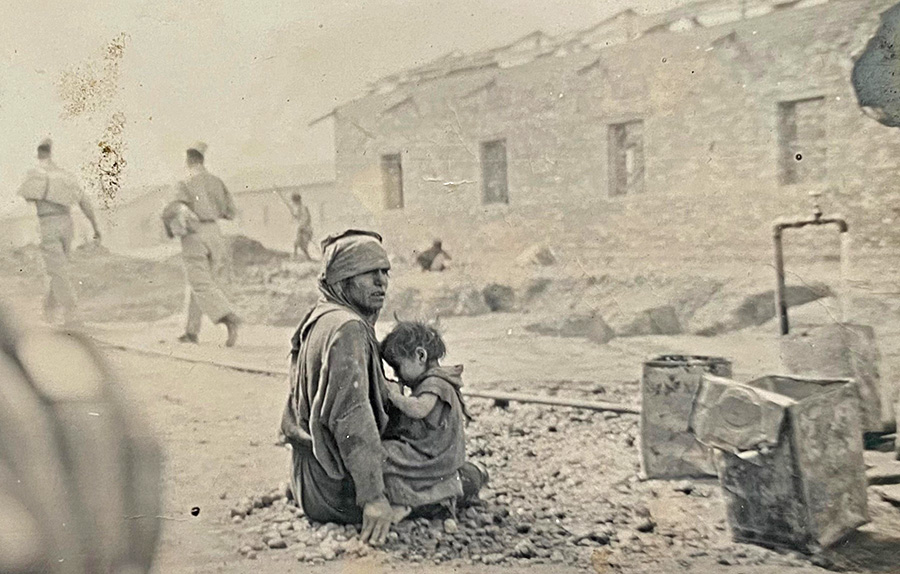
| A starving mother and child sit in one of the ruined streets of Tehran as Allied soldiers walk through the city during the Second World War occupation of Iran, August 1941-May 1946. |
The British forced the abdication of Reza Shah Pahlavi. They reluctantly accepted his son, Mohammad Reza Pahlavi, as his successor. Although Iran remained formally independent, it was effectively under Allied control. Much of the country's transportation infrastructure, including its railways, roads, and ports, was placed under Allied administration.
The Allied occupation significantly disrupted Iran's economy. Transportation networks were heavily prioritized for military logistics, making it difficult to move grain and other food supplies between cities and provinces. Almost all transport capacity was dedicated to the military operations of the occupying forces rather than to civilian needs.
The presence of hundreds of thousands of Allied troops increased demand for food and other essential goods. Combined with wartime shortages, this contributed to rapid inflation. The Iranian government struggled to regulate prices and ensure the equitable distribution of food.
Many urban residents found that their wages failed to keep pace with rising prices, reducing their ability to purchase staple foods such as bread. Even where grain production remained relatively stable, the distribution of food became increasingly difficult. Hoarding by merchants, speculative trading, inadequate transportation, and administrative inefficiency further worsened the food shortages. Government efforts to impose price controls were often undermined by corruption and the state's limited state authority.
Some regions also experienced unfavorable weather. Although this was not the sole cause of the famine, it contributed to reduced agricultural production. Initial American relief efforts failed to materialize after the American ambassador, Louis G. Dreyfus, reported to Washington that Iran was not experiencing a severe famine. He argued and insisted that it should not be prioritized over the broader Allied war effort against the Axis powers.
|
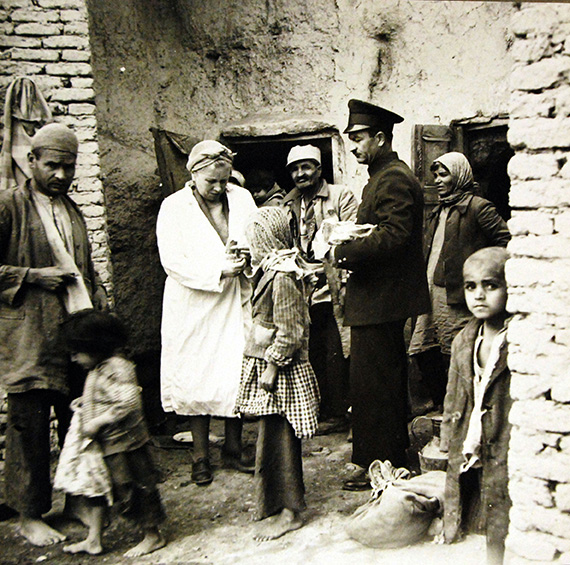
| Grace Dreyfus, wife of the American ambassador Louis G. Dreyfus, distributes food in Tehran 1943. |
Allied policies contributed significantly to the crisis by prioritizing military transportation over civilian food distribution and requisitioning transport resources. However, internal Iranian factors also played an important role, including weak governance, ineffective administration, corruption, hoarding, and market speculation.
James S. Moose, Jr., the American consul who traveled through eastern, central, and southern Iran in April 1941, authored a formal diplomatic report on May 23, 1941, addressed to Wallace Murray, Chief of the U.S. State Department's Division of Near Eastern Affairs. In this dispatch, Moose described severe nationwide food shortages and rapidly rising prices in Iran in the months preceding the joint Anglo-Soviet invasion of August 1941. He further reported that grain monopoly agents were collecting grain in the Bojnord region for export to Germany through the Soviet Union.
The Iranian government attempted several measures to alleviate the crisis, including bread rationing, price controls, and grain procurement programs. These efforts achieved only limited success because of transportation bottlenecks, inadequate administrative capacity, and continuing Allied wartime demands. Compared with the scale of the crisis, international relief remained relatively insignificant.
In many cities, including the capital, Tehran, Iranians organized mass protests against the Allied occupation, accusing the occupying forces of causing widespread famine and inflation, as well as looting the country. An enormous influx of European refugees, particularly Polish refugees, and the allocation of food supplies to them further fueled public resentment at a time when many Iranians were dying of starvation and lacked access to adequate food. These protests were suppressed by the authorities under the British-backed Prime Minister Ahmad Qavam.
The famine during the Anglo-Soviet occupation contributed to growing anti-Western sentiment in Iran, which, together with subsequent foreign interventions such as the 1953 coup, helped shape the country's later distrust of the West. The fact that all of the regions most severely affected by the famine were located in the British Occupation Zone further strengthened these perceptions.
The Iranian famine of 1942–1943, which is estimated to have claimed the lives of between 2 and 4 million Iranians, remains an important yet sometimes overlooked episode in Iran's modern history. It has received relatively limited attention in Western scholarship. Histories of the Second World War have often focused on military operations and the strategic importance of the Persian Corridor, giving comparatively little attention to civilian suffering in Iran.
Since the late twentieth century, recent research has increasingly examined this issue and highlighted how the famine illustrates the catastrophic humanitarian consequences that can result from military occupation and foreign intervention.
The famine in Iran during the Second World War has received relatively limited attention in Western scholarship. Mohammad Gholi Majd, who earned a Ph.D. in agricultural economics from Cornell University, conducted and wrote the very first serious English-language study of the Iranian famine of 1941–1943. In an article published in the "Journal of Iranian Islamic Period History," Majd argued that between 3 and 4 million Iranians—approximately one quarter of the country's population—died from starvation and disease during the Allied occupation. He based this estimate on U.S. State Department population figures indicating that Iran's population was approximately 15 million in 1941 and between 10 and 12 million in 1944.
Bibliography:
- Dreyfus, Louis G. Telegrams and Diplomatic Correspondence on Iran, 1941. The telegrams from Iran are available through the Department of State's Foreign Relations of the United States (FRUS) Archives and Records Administration, Washington, D.C.
- Majd, Mohammad Gholi. “The Great Famine and Genocide in Iran, 1941–1944.” Journal of Iranian Islamic Period History.
- Ervand Abrahamian. A History of Modern Iran. Cambridge: Cambridge University Press, 2008.
- Majd, Mohammad Gholi. Iran Under Allied Occupation: The Crisis of 1941–1946. Lanham, MD: University Press of America, 2016.
- Moose, James S., Jr. “Report on Conditions in Iran.” May 23, 1941. Record Group 59 at U.S. Department of State Records, National Archives and Records Administration, Washington, D.C.