
The United States of America Massacred Children and Teachers of Minab Elementary School in 2026
By: Shapour Ghasemi, 2026At 10:00 a.m. Tehran local time on Saturday, 28 February 2026, the United States and Israel, with the support of their regional allies, launched an unprovoked attack on Iran in an operation called “Epic Fury.” This marked the beginning of illegal military actions against Iran, its people, and its civilian infrastructure. The primary objective of the United States and Israel was to topple the Iranian government and install a puppet regime in Tehran.
|
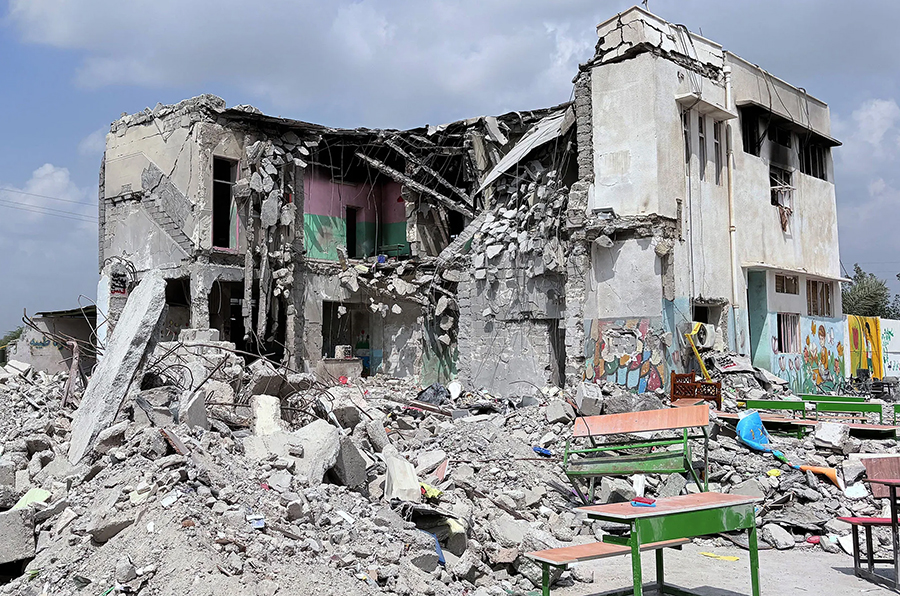
| Shajareh Tayyebeh Elementary School in Minab, Iran, was struck by multiple Tomahawk cruise missiles reportedly launched from a U.S. Navy warship. |
The idea of regime change in Iran had long been under consideration and was strongly promoted and vigorously lobbied for by Israel. Eventually, Israeli Prime Minister Benjamin Netanyahu convinced U.S. President Donald Trump that a military campaign against Iran would be swift and decisive and that the Iranian government would fall within a day or two. He further argued that the Iranian people would rise up against their government and that the armed forces would lay down their arms in solidarity with the population. It should be noted that, over the previous 15 years, Israel had invested heavily in Reza Pahlavi, the son of the last shah of Iran, who was ousted in 1979 by a popular revolution. Reza Pahlavi had openly lobbied the United States and Western powers to take military action against Iran.
The significant advocacy role played by U.S. allies in the Middle East and the Persian Gulf region, including Saudi Arabia, the United Arab Emirates, Bahrain, Qatar, and Kuwait, in shaping consensus among members of the U.S. administration and lawmakers in Washington, D.C., should not be overlooked. Other countries, including Jordan and Egypt, also played an active role behind the scenes by providing vital logistical support to the U.S. military campaign.
| Donald Trump announcing the U.S.–Israeli strikes on Iran on 28 February 2026, encouraging regime change in the country |
In the first 12 hours of the war against Iran, the United States and Israel, in pursuit of their primary objective of toppling the Iranian government, bombed more than 900 targets across Iran using air raids and missile strikes. In the early hours of these attacks, they assassinated Iran’s Supreme Leader, Ayatollah Khamenei, along with several members of his family, including his daughter and granddaughter, as well as top-ranking military officials, in an attempt to create a power vacuum.
The United States and Israel primarily targeted residential areas in order to maximize civilian casualties and provoke an artificial uprising against the Iranian government, a strategy that appeared to follow the classic logic of “destabilization theory.”
Iranians have been enduring severe economic hardship, primarily as a result of 47 years of economic sanctions imposed unilaterally by the United States and its Western allies and, to a lesser extent, due to the mismanagement of successive Iranian administrations. These conditions have contributed to several waves of protests over the past decade.
Taking Iran’s internal situation into account, the United States and Israel designed their military operation to maximize psychological pressure on the Iranian population and achieve their objectives by exploiting widespread public frustration. They appeared to believe that several days of intense and destructive bombardment would trigger an uprising among dissatisfied segments of Iranian society.
In an apparent effort to push Iranians to a breaking point, the United States launched its military campaign against Iran on Saturday, 28 February 2026, the first day of the war and a working day in Iran, by striking Shajareh Tayyebeh Elementary School in Minab, Hormozgan Province, in southern Iran, at approximately 10:00 a.m. local time. The school, which provided co-located single-gender education for young children, was destroyed by Tomahawk cruise missiles launched from a U.S. Navy warship. Independent legal analyses and witness accounts corroborated by satellite imagery and geolocation evidence confirm that the school compound was struck three times in a devastating sequence. This tactical sequence, often referred to by experts as a "triple tap" strike, significantly maximized the loss of life.
The First Strike: During the morning school session, a missile struck the school compound, causing a severe partial collapse of the building and leaving many students trapped beneath the rubble. According to testimony provided to “Middle East Eye” by a “Red Crescent” medic and the parent of a victim, the school principal, in the immediate aftermath of the strike, attempted to relocate surviving students to a centrally located interior prayer room for protection while urgently contacting parents to evacuate their children.
The Second Strike: Shortly after the initial attack, a second missile struck the compound, according to another Red Crescent medic who spoke to Middle East Eye. The missile directly hit the interior prayer room where students and faculty members had taken shelter. This second strike is widely considered to have caused the vast majority of the more than 168 confirmed deaths, most of them girls between the ages of 7 and 12. One parent corroborated this account, stating that he had received a call from the school informing him that his daughter had survived the first strike; however, before he could arrive, the school was struck again, and she was killed.
The Third Strike: Moments later, a final missile struck the school compound. The third impact completely destroyed the remaining structural sections of the building and significantly impeded early rescue and recovery operations. According to Minab's mayor and the Iranian Ministry of Education, the school was subjected to a "triple tap" attack, having been struck three times in total. Satellite-based analysis by BBC Verify suggests that the area containing the school was hit by multiple missiles.
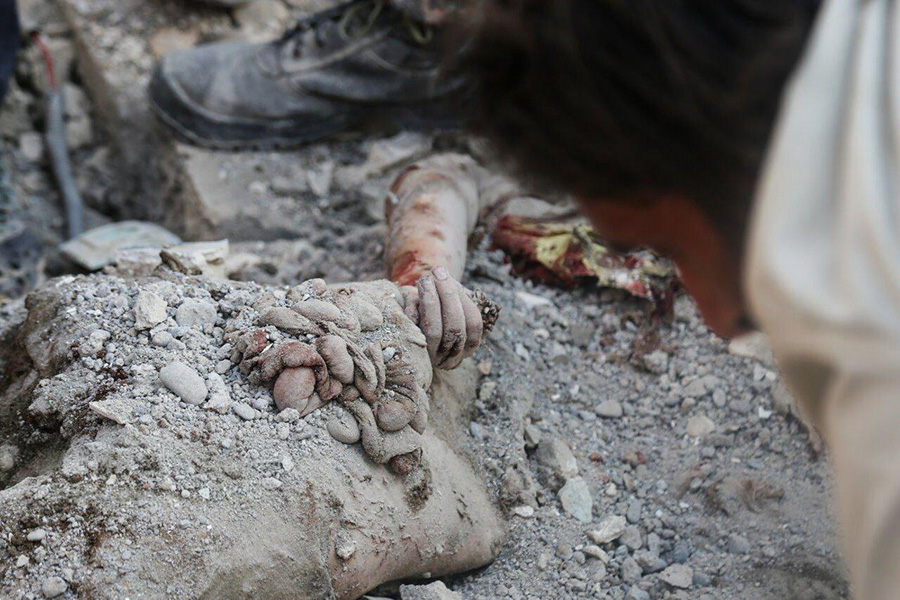
The strike instantly killed dozens of people inside the building. It affected more than half of the structure, destroying walls and causing the roof to collapse, burying many victims beneath the rubble. Graphic footage shows that some bodies were partially trapped under the rubble. The explosion destroyed at least half of the two-story school building.
|
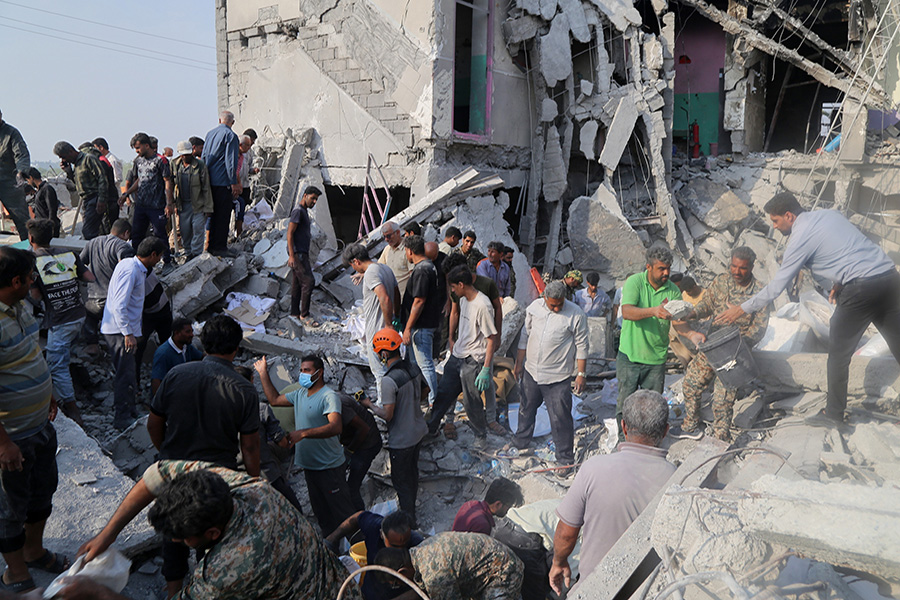
| After the strikes on Shajareh Tayyebeh Elementary School, the people of Minab were using their bare hands to recover the bodies of victims and rescue any possible survivors. |
|
| The severed arm and body of a girl trapped beneath the rubble of Shajareh Tayyebeh Elementary School, which was destroyed by U.S. Navy Tomahawk cruise missiles on February 28, 2026, in Minab, Iran. |
In addition to the three missiles that struck and destroyed the school, another twelve structures nearby within the Islamic Revolutionary Guard Corps Navy (IRGCN) compound were significantly damaged by airstrikes sometime after 10:20 a.m., including the Shahid Absalan Specialist Clinic, which had begun treating those injured in the earlier attack on the school.
The attack was condemned by UNESCO, Amnesty International, UN High Commissioner for Human Rights, and other international human rights organizations and activists as a violation of international humanitarian law.
Following multiple independent investigations and its own in-depth inquiry, Amnesty International published findings that it said provided compelling evidence that the United States was responsible for the strike. The organization concluded that the U.S. military had used a U.S.-manufactured Tomahawk subsonic cruise missile in the devastating strike on Shajareh Tayyebeh Elementary School in Minab, Iran, on 28 February 2026.
For planning Operation Epic Fury, the U.S. military utilized the Maven Smart System, an artificial intelligence platform designed to streamline the targeting process, significantly reduce personnel requirements, and generate up to 1,000 target packages per hour with high precision. These capabilities strongly suggest that the strike on the school is unlikely to be attributed to human error, particularly as the target was struck three times over what appears to have been a deliberate and calculated time interval.
|
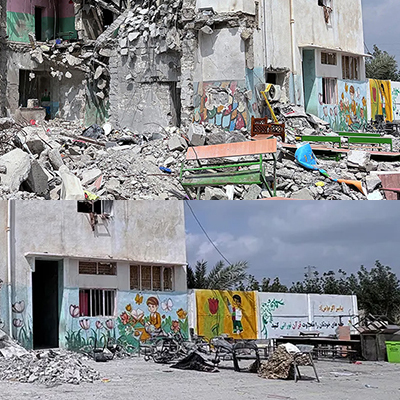
| Colorful murals on the walls of Shajareh Tayyebeh Elementary School in Minab, Iran. The school was destroyed by U.S. Navy Tomahawk cruise missiles on February 28, 2026. |
Shajareh Tayyebeh Elementary School, located in southern Minab, was attended by both boys and girls, who were taught on separate floors. The school was situated near the Islamic Revolutionary Guard Corps Navy (IRGCN) Sayyid al-Shuhada military complex. As of early 2026, the school had operated as a civilian educational institution for more than a decade, remaining in close proximity to, but visibly separate from, the IRGCN compound. According to satellite imagery, the building housing the school was enclosed within the IRGCN compound in 2013 but had been separated from the rest of the compound by a wall by at least September 2016. The school's external wall had three entrances that were separate from the rest of the compound, allowing access without passing through the compound itself, and none was equipped with a military security checkpoint. Satellite imagery from August 2017 showed an outdoor play area. The investigation found no indication that the building served any military purpose and determined that the adjacent buildings within the compound housed a medical clinic and a pharmacy. In addition, the compound's four military security posts had been removed by 2016. The school also maintained what Reuters described as a "vivid website and years-long online presence." Images of the bombed Shajareh Tayyebeh Elementary School show brightly painted football (soccer) and volleyball pitches, as well as walls covered with colorful murals depicting children.
It is difficult to conclude that the U.S. War Department, supported by sophisticated spy satellites with high-resolution imaging systems, was unaware that Shajareh Tayyebeh Elementary School was a civilian school rather than a military compound.
|
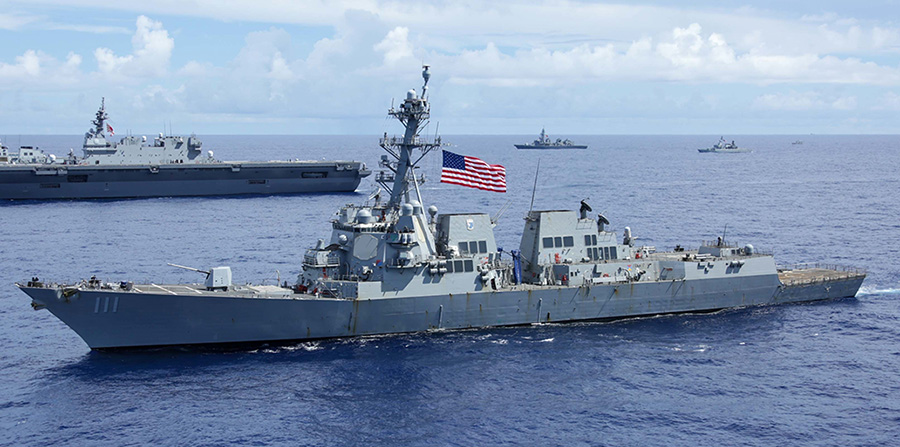
| The U.S. Navy warship USS Spruance (DDG-111) under the command of Commanding Officer Leigh R. Tate and Executive Officer Jeffrey E. York that launched several Tomahawk missiles on February 28, 2026, at Shajareh Tayyebeh Elementary School, which killed 156 children, teachers, staff, and several parents. |
Soon after strikes stopped, recovery efforts began, as civilians, Iranian Red Crescent Society emergency workers, and family members of victims rushed to the scene and searched through the debris with their bare hands. Rescue services also brought in construction cranes and shovels to retrieve people trapped under the rubble.
Images taken by people at the scene reveal items including severed arms, bodies, and school bags being recovered. Other imagery confirms that areas struck within the school were used for educational purposes.
Videos and photos taken immediately following the attack, showing the destroyed school and bodies at the scene, were verified as authentic by major news outlets and fact-checking organizations, including Reuters, The Washington Post, and The New York Times.
Later, on the day of the airstrike, the victims’ bodies were handed over to their relatives at a nearby designated collection area. The attack and high death toll overwhelmed Minab’s morgues, forcing some of the bodies to be stored in refrigerated trucks.
Iranian authorities announced the end of search and rescue operations for victims and survivors on March 1, 2026.
According to Iranian official figures, the final death toll was 156, including 120 students, of whom 73 were boys and 47 were girls; 26 teachers, including the principal; 3 school transport staff; and 7 parents. An additional 96 people were injured.
|
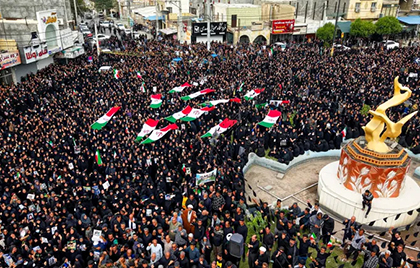
| Thousands of mourners attended the mass funeral held on March 3, 2026, for the victims of the U.S. Navy Tomahawk Cruis missle strike on Shajareh Tayyebeh Elementary School in Minab, Iran. |
|
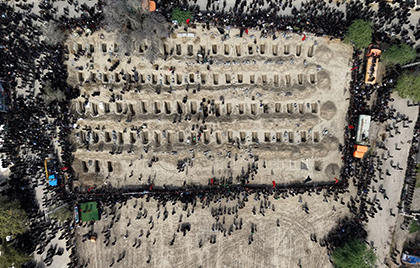
| Raws of small graves in Hermud Cemetery in Minab await the bodies of children killed in the U.S. Navy Tomahawk cruise missile strike on Shajareh Tayyebeh Elementary School in Minab, Iran. |
Iran held a mass funeral for the children and others killed in the airstrike at Shohada Square and Hermud Cemetery in Minab on March 3, 2026, attended by thousands of mourners.
Following the attack, U.S. President Donald Trump claimed, without providing evidence, that Iran possessed Tomahawk missiles and suggested that Iranian Tomahawks may have been responsible for the strike on the school. PBS fact-checkers rated Trump’s claim as false, noting that the United States is the only party in the conflict known to possess Tomahawk missiles. They also cited video evidence released by U.S. Central Command showing that the U.S. Navy had launched several Tomahawks on February 28, 2026, the same day Shajareh Tayyebeh Elementary School was struck. The U.S. Navy warship that launched several Tomahawk missiles on February 28, 2026, was the USS Spruance (DDG-111), under the command of Commanding Officer Leigh R. Tate and Executive Officer Jeffrey E. York.
Additionally, the U.S. and Israel had divided their strikes geographically, with the U.S. responsible for targeting southern Iran, where the school was located.

|

|
|
Commanding Officer of USS Spruance (DDG-111): Commander Leigh R. Tate |
Executive Officer of USS Spruance (DDG-111): Commander Jeffrey E. York |
The New York Times reported on March 11, 2026, that preliminary findings of the investigation determined that the United States was responsible for the strike. The inquiry further suggested that the Shajareh Tayyebeh Elementary School had likely been targeted as a result of outdated coordinates supplied by the Defense Intelligence Agency. This explanation can hardly be reconciled with the capabilities of the U.S. intelligence-gathering apparatus, as it would suggest that the U.S. War Department relied on intelligence that was at least ten years old.
Some sources familiar with the logistics of the strike told The Washington Post that intelligence had tagged Shajareh Tayyebeh Elementary School as either a factory or an arms depot before it was approved as an airstrike target. Numerous reports, news outlets, and U.S. senators subsequently raised concerns over the U.S. War Department’s use of artificial intelligence (AI) tools, including Palantir’s Maven Smart System and Claude systems.
In assessing the U.S.–Israeli strikes, particularly the reported “three-tap” strikes on Shajareh Tayyebeh Elementary School, it is important to note that under international humanitarian law (IHL), schools and children under the age of 18 are afforded special protection. UN human rights experts have also indicated that the strike may constitute a potential war crime under the Rome Statute.
It may never be determined whether the school was intentionally classified as an arms-producing factory or a military depot by human analysts, or tagged as such by a faulty AI system. However, this possibility should be considered in the broader context of Operation “Epic Fury,” a war on Iran aimed at toppling and replacing the Iranian government with a regime aligned with Israeli interests. The U.S. president, Donald Trump, explicitly declared regime change to be a core U.S. military objective. He made the remarks during an official eight-minute video address released as joint U.S.–Israeli military strikes commenced. In the address, he directly called on the Iranian people and military to “lay down your weapons” and “take over your own government.”
According to this interpretation of the campaign's objectives, the goal of toppling the Iranian government involved strikes on hospitals, universities, residential buildings, medical centers, pharmacies, schools, and other civilian infrastructure. These attacks were intended to provoke public frustration and dissatisfaction and potentially incite revolt against the government in Tehran. The U.S. and Israel relied on existing economic discontent among the Iranian population, and the military plan was based on a bombardment campaign lasting only a few days, up to a week.
Despite the military planning and firepower behind Operation “Epic Fury,” and despite the indiscriminate strikes on exclusively civilian targets that caused immense human suffering, the primary objectives of the campaign remained far from being achieved. Political leaders, intelligence analysts, and military planners in both the United States and Israel had not anticipated Iran’s capacity to retaliate militarily, nor the strength of Iranian patriotism and national unity in support of their government. Although many Iranians were dissatisfied with their government, they perceived the war not as an attack on the Islamic Republic, but as an assault on their motherland, Iran.
Sources:
- How Trump has addressed the deadly Iran school bombing (Aljazeera)

- Iran school and nearby military base struck multiple times, satellite image reveals (BBC)
- What we know about the strike on a school in Iran as the death toll rises (NBC News)
- The final death toll from the attack on the Shajareh Tayyebeh school is 156 (Asr-Iran)
- UN body investigating fatal strike on Iranian girls' school (Reuters)
- USA/Iran: Those responsible for deadly and unlawful US strike on school that killed over 100 children must be held accountable (Amnesty International)
- More Than 100 Reported Killed in Strike on Girls’ Elementary School in Iran. Here’s What We Know (Time)
- At least 153 dead after reported strike on school, Iran says (BBC)
- Satellite images show Iran school strike hit more buildings than earlier reported (NPR)
- Al Jazeera investigation: Iran girls’ school targeting likely ‘deliberate’ (Aljazeera)
- Minab school bombing: how the worst mass casualty event of the Iran war unfolded – a visual guide (Guardian)
- US and Israeli attack on Iran: At least 153 girls killed in strike on school (Middle East Eye)
- U.S. at Fault in Strike on School in Iran, Preliminary Inquiry Says (The New York Times)
- UN 'deeply disturbed' by strike on Iran school that killed 160 children (Reuters)
- Trump says he believes bombing of Iranian girls' school was "done by Iran” (CBS)