Mohammad Reza Shah, king of Iran, 1941–1979, was born in Tehran on October 26, 1919, the eldest son of Reza Shah Pahlavi), founder of Pahlavi Dynasty, and Tadj ol-Molouk. As crown prince, he was educated in Switzerland at the Institut Le Rosey before returning to Iran in 1935 to complete his military training at the Iranian Military Academy, from which he graduated in 1938.
In 1939 he married Princess Fawzia of Egypt, sister of Farouk I of Egypt; the marriage ended in divorce in 1948. He later married Soraya Esfandiary, 1950–1958, and Farah Diba, married 1959. His third marriage produced the long-awaited male heir, Crown Prince Reza Pahlavi.
Mohammad Reza ascended the throne in September 1941 after the Anglo-Soviet invasion of Iran during World War II. British and Soviet forces, concerned about Reza Shah’s perceived sympathies toward Germany and Iran’s strategic importance, in 1941, the two countries invaded and occupied large areas of Iran. They forced Reza Shah to abdicate and, in the absence of a viable alternative, permitted Mohammad Reza to assume the throne.
Wedding of Crown Prince Mohammad Reza with Princes Fouzieh of Egypt, sister of King Farouk I, Cairo 1939.
The young shah inherited a politically fragile state marked by foreign occupation, economic strain, and the reemergence of parliamentary politics. The early years of his reign were characterized by limited royal authority and the resurgence of political parties and press freedoms. The new Shah’s reign began against a backdrop of social and political disarray, economic problems, and food shortages.
Despite his vow to act as a constitutional monarch who would defer to parliamentary authority, Mohammad Reza increasingly involved himself in governmental affairs and opposed or thwarted strong prime ministers. Prone to indecision, he relied more on manipulation than decisive leadership. He concentrated on reviving the army and ensuring that it remained under royal control as the monarchy’s main power base. In 1949, an assassination attempt on the Shah, attributed to the pro-Soviet Tudeh Party, resulted in the banning of that party and the expansion of the Shah’s constitutional powers.
Tensions between the monarchy and nationalist forces culminated in the premiership of Mohammad Mosaddeq, who nationalized the Anglo-Iranian Oil Company in 1951. The ensuing crisis intensified domestic polarization and international intervention. In August 1953, Mosaddeq was removed by a CIA and British intelligence services orchestrated coup d'état, supported by elements within Iran. The episode significantly strengthened the shah’s political position while shaping long-term debates over foreign influence and legitimacy.
Mohammad Reza Shah with Stalin and USSR Foreign Minister Molotov, Tehran 1943.
After 1953, the shah gradually consolidated authority, marginalizing independent political forces and strengthening the executive branch. In the context of regional turmoil and the Cold War, the Shah established himself as an indispensable ally of the West.
Domestically, he advocated reform policies, in 1963 he launched the White Revolution, a wide-ranging reform program including land redistribution, expansion of women’s suffrage, literacy campaigns, profit-sharing for industrial workers, and rural development initiatives. These measures aimed to modernize Iran’s socioeconomic structure, weaken traditional elites, and promote state-led development.
The reforms produced mixed outcomes. Land reform disrupted traditional agrarian relations but did not yield sustained rural prosperity; instead, it forced Iran to import wheat for the first time. The reform policies of the White Revolution caused discontent among religious leaders and clerical community.
The Shah during his Hajj pilgrimage, Mecca in 1957.
On June 3, 1963, Ayatollah Khomeini delivered a sermon at the Feyziyeh School in Qom, where he denounced the Shah, comparing him to a tyrant, and criticized aspects of the reforms, particularly their secular orientation and perceived alignment with Western interests. Two day later Khomeini was arrested by the security forces. Subsequently, protests sparked across Iran, in Qom, Tehran, Mashhad, Shiraz, against Shah. The government responded with force: troops, tanks, and shoot-to-kill orders were used to suppress demonstrations.
Urbanization accelerated, educational access expanded, and new middle classes emerged. However, the combination of rapid social transformation, uneven development, and restricted political participation structurally intensified discontent among educated youth.
The Shah's regime suppressed and marginalized its opponents with the help of Iran's security and intelligence organization, SAVAK, Sazman-e Ettelaat va Amniyat-e Keshvar. The political repression, censorship, and the absence of meaningful representative institutions undermined regime legitimacy.
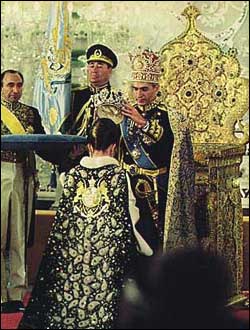
Coronation of Mohammad Reza Shah and Queen Farah,
Tehran 1967.
During the Cold War, the shah positioned Iran as a strategic ally of the United States and a pillar of regional stability in the Persian Gulf. Iran joined Western-backed security arrangements.
In 1967, the shah crowned himself Shahanshah, “King of Kings,” and his wife, Farah Diba, as Shahbanoo, Empress, which caused discontent among various segments of society.These measures, along with the increasing arbitrariness of the Shah’s rule, students and intellectuals seeking democratic reforms. Critics accused the Shah of violating the constitution, which limited royal power and provided for representative government, and of being subservient to the United States. Seeing himself as heir to the kings of ancient Iran, he held an extravagant but controversial celebration in 1971 marking 2,500 years of Persian monarchy.
The Shah pursued discreet yet substantive diplomatic relations with Israel. Relations between the two countries were strengthened through security cooperation, with Israel providing assistance and training to SAVAK in exchange for Iranian oil. At the same time, the Shah sought to expand Iran’s regional influence by cultivating closer relations with Arab states. During the 1973 Arab–Israeli War, the Shah allowed Soviet aircraft to pass through Iranian airspace to deliver military supplies to Egypt, and Iran provided financial and oil support to Egypt. After Arab–Israeli War of 1973, he adopted a more publicly pro-Arab posture, endorsing calls for Israeli withdrawal from occupied territories and expressing support for Arab political positions. Although Iran maintained economic and intelligence ties with Israel, this recalibration of policy contributed to a gradual cooling of Iran–Israel relations. The Shah aimed to position Iran as a dominant Persian Gulf power while avoiding diplomatic isolation in the Arab world. He supported the idea that Israel should return occupied territories to the Palestinians. In a 1973 interview with Oriana Fallaci, the Shah expressed his view that Israel’s occupation of Arab and Palestinian lands was unlawful. In 1974, in an interview with Mike Wallace, he criticized the influence of the US-Jewish lobby, AIPAC, on American politicians and lawmakers. He repeated similar criticisms in another interview in 1976. The Shah’s criticism of Israel and AIPAC made him a less favorable partner for the United States and Israel in the Middle East.
Royal familiy visit shrine of Imam Reza in Mashhad, Queen Farah is in chador on the back, Mashhad 1971.
After the 1973 oil price shock, Iran experienced an unprecedented increase in oil export earnings. The oil boom increased liquidity in the Iranian economy at a rate that far outpaced the capacity of other sectors to absorb it. The government’s budget became heavily reliant on oil revenues, which financed expansive state investment programs, rising military expenditures, and a dramatic increase in public consumption. Because fiscal planning mechanisms were not designed to manage such large fluctuations in oil income, state spending expanded rapidly in response to revenue flows, under the direct direction of the Shah.
Oriana Fallaci interviewed the Shah in 1973; the interview was later published in 1977 in her book Interview with History. On page 264, she writes about the Shah:
“He considers women as simply graceful ornaments, incapable of thinking like a man, and then strives to give them complete equality of rights and duties.”
In response to Q18, the Shah says the following:
“Women are important in a man’s life only if they’re beautiful and charming and keep their femininity and … This business of feminism, for instance. What do these feminists want? What do you want? You say equality. Oh! I don't want to seem rude, but … You're equal in the eyes of the law but not, excuse my saying so, in ability.” see the full interview >>>>>
In 1976, he replaced the Islamic calendar with an “imperial” calendar beginning with the foundation of the Persian Empire more than 25 centuries earlier. These actions were widely viewed as anti-Islamic and intensified religious opposition.
By the mid-1970s, the Shah ruled amid widespread discontent caused by the regime’s repression, socioeconomic changes that benefited some classes at the expense of others, and the widening gap between the ruling elite and the general population. Economic strains, including inflation, uneven wealth distribution, and pressures associated with rapid development, combined with political grievances and cultural tensions to create a broad coalition of religious leaders, secular intellectuals, bazaar merchants, students, and workers mobilized against the monarchy.
Mohammad Reza Shah met with Richard Nixon in the Oval Office on July 24, 1973, during a state visit to the United States.
From 1978 onward, widespread uprisings, nationwide protests and strikes intensified. Despite attempts at reform and conciliation, the regime’s authority eroded. Islamic leaders, particularly the exiled cleric Ayatollah Khomeini, were able to channel this discontent through a populist ideology rooted in Islamic principles and calls for the overthrow of the Shah.
As a consequence of the Shah’s position on the Arab–Israeli War and his views on the Palestinian-occupied territories, during the uprisings of 1978 and the Revolution of 1979, the United States gradually distanced itself from the Shah and began exploring channels of communication with Ayatollah Khomeini as a potential future leader of Iran, seeking to safeguard American and Israeli interests and maintain regional stability.
In January 1979, amid mounting unrest and while suffering from advanced cancer, the Shah left Iran and began a life in exile. In February 1979 revolutionary forces declared the end of the monarchy and established the Islamic Republic under the leadership of Ayatollah Khomeini.
Mohammad Reza Shah and Farah are leaving Iran for good,
16 January 1979.
The Shah spent his final months in exile, wandering through several countries, including Egypt, Morocco, the Bahamas, and Mexico. Most countries refused to shelter the Shah and his family, including the United States, his longtime ally. Ultimately, David Rockefeller, chairman of Chase Manhattan Bank, and Henry Kissinger, former Secretary of State, lobbied the Carter administration to grant the Shah entry to the United States for treatment of his lymphatic cancer. His arrival in New York City contributed to the seizure of the U.S. Embassy in Tehran and the ensuing hostage crisis.
In 1980, when the Shah’s cancer treatment proved ineffective, President Sadat invited him to spend his final days in Egypt. He ultimately died in Cairo on July 27, 1980.
Bibliography
Abrahamian, Ervand. Iran Between Two Revolutions. Princeton University Press, 1982.
Abrahamian, Ervand. The Coup: 1953, the CIA, and the Roots of Modern U.S.-Iranian Relations. The New Press, 2013.
Abrahamian, Ervand. A History of Modern Iran. Cambridge University Press, 2018.
Gasiorowski, Mark J., and Malcolm Byrne, eds. Mohammad Mosaddeq and the 1953 Coup in Iran. Syracuse University Press, 2004.
Kapuściński, Ryszard. Shah of Shahs. Harcourt Brace Jovanovich, 1982.
Milani, Abbas. The Shah. Palgrave Macmillan, 2012.
Pahlavi, Mohammad Reza Shah. Answer to History. Stein and Day, 1980.