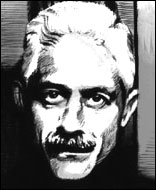
Jalal Al Ahmad, Son of a Shi'ite clergyman, was born in 1923 in Tehran. His early education consisted of the normal Iranian curriculum in the 1930s as well as study of the French and English. In 1946 he graduated from Teachers College and became a teacher, at the same time making a sharp break with his religious family. He pursued academic studies at Tehran University and received an MA in Persian literature.
Al Ahmad joined the Tudeh Party shortly after World War II. In late 1940’s he distanced himself from Tudeh Pary as it was openly pro Soviet. He supported the Oil Nationalization movement of Dr. Mohammad Mosaddeq nationalist government. Following the 1953 CIA orchestrated coup d'état Al Ahmad was imprisoned for several years.
In 1950, Al Ahmad married with Simin Daneshvar another young and energic writer. However, from 1945 to 1968 he wrote novels, essays, travelogues and ethnographic monographs. The subjects of his works were mainly cultural, social and political issues, symbolic representations and sarcastic expressions. In his works he paid attention to the superstitious beliefs of the common people and their exploitation by Shi’ite clergy.
He has translated some French works into Persian; like "Les mains sales" by Jean-Paul Sartre and "The Gambler" by Fyodor Dostoyevsky.
Al Ahmad traveled to poor and far-off regions of Iran and tried to document their life, culture and problems. Some of these monographs are mentioned below.
In 1962, Al Ahmad published “Gharbzadegi” commonly translated into English as "Weststruckness", which is his most famous critical essay. In “Gharbzadegi” he writes a "stinging critique of western technology and civilization. He argued that the decline of traditional Iranian industries such as carpet-weaving were the beginning of Western "economic and existential victories over the East." His message was widely embraced by Ayatollah Khomeini and later by other revolutionaries during the 1979 Iranian revolution.
Al Ahmad died in 1969; commonly believed he was poisoned by the agents of SAVAK, Shah's security service.
Novels and novellas:
"The school principal" or “Head Master”
"By the pen"
"The cursing of the land"
"The tale of beehives"
"A stone upon a grave"
Jalal Al Ahmad
Short stories
"The Setar"
"Of our suffering"
"Someone else's child"
"Pink nail-polish"
"The Chinese flower pot"
"The postman"
"The treasure"
"The Pilgrimage"
"Sin (Gonah)"
Critical essays
"Seven essays"
"Hurried investigations"
“Weststruckness” or "Plagued by the West" “Gharbzadegi”
Travelogues
"A straw in Mecca"
"A journey to Russia"
"A journey to Europe"
"The land of Azrael"
"A journey to America"
Monographs
"Owrazan" in Taleghan mountains
"Kharg Island, the unique pearl of the Persian Gulf"

 |
|