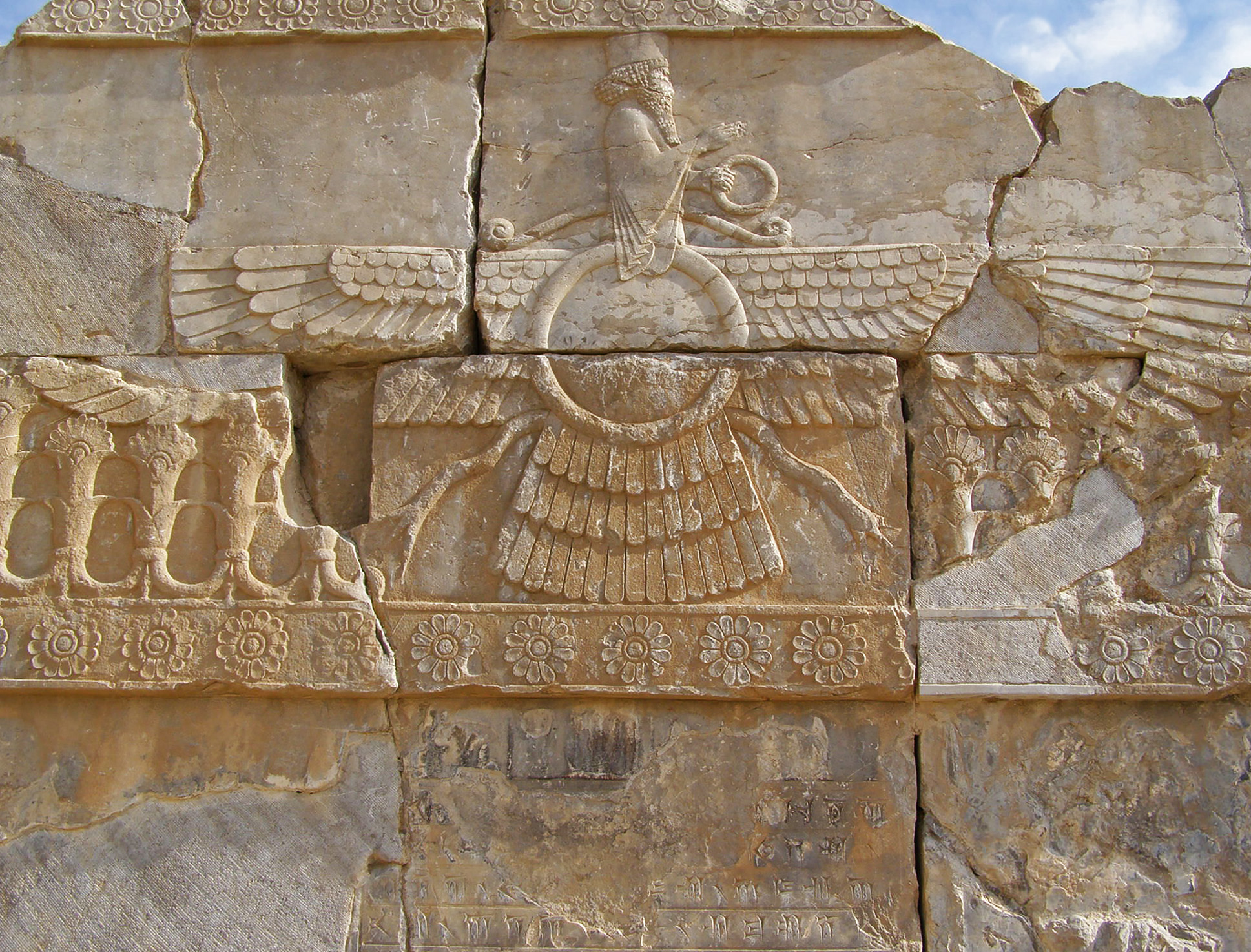
Faravahar is the best-known symbols of Zoroastrianism,
Persepolis, Iran
Early Beliefs and the Rise of Zoroastrianism
In the earliest periods of Iranian history, before the emergence of the empires of the Medes and the Persians, the Aryan inhabitants of the Iranian plateau practiced polytheism. Like many ancient peoples, they revered the forces of nature and worshiped phenomena such as fire, water, wind, the sun, and the moon. These elements were not merely physical realities but were regarded as sacred manifestations of divine power governing the universe.
Around the seventh century BCE, a profound religious transformation occurred with the appearance of Zoroastrianism. This new faith is traditionally associated with the prophet Zoroaster, who is believed to have been born in the region of Azerbaijan. From there, the religion gradually spread southward to Parsa, the homeland of the Achaemenid dynasty.
The first Achaemenid ruler who is widely believed to have formally embraced Zoroastrianism was Darius I, 550–486 BCE. In contrast, earlier rulers such as Cyrus the Great and his son Cambyses II appear to have followed the religious traditions of their ancestors while showing tolerance toward the diverse beliefs of their subjects. Darius, however, explicitly invoked Ahura Mazda in his inscriptions, declaring that all his victories and achievements were granted through the grace of this supreme deity. These inscriptions provide some of the earliest historical evidence for the organized form of Zoroastrian belief.
In its early form, Zoroastrianism presented a strong monotheistic tendency centered upon Ahura Mazda as the supreme God. The early Zoroastrians buried their dead, as evidenced by the royal tombs of Achaemenid kings. They rejected the use of statues or physical representations of their deity and did not construct temples filled with idols. Instead, they are believed to have offered prayers and sacrifices in open spaces, often on mountaintops, symbolizing purity and closeness to the divine. Truthfulness was considered a fundamental moral principle, and lying was strongly condemned as a grave sin.
The sacred scripture of the religion is the Avesta, within which the Gathas are traditionally regarded as the hymns composed by Zoroaster himself. Through its ethical emphasis on truth, righteousness, and devotion to one supreme God, Zoroastrianism stands among the earliest known expressions of ethical monotheism. Indeed, some historians suggest that Zoroastrian ideas may have influenced and reinforced the concept of the monotheistic traditions, including Judaism, particularly in shaping concepts of divine justice and cosmic struggle between good and evil.
Over time, however, Zoroastrianism evolved. Elements from older Iranian beliefs and neighboring traditions were incorporated into its theology. Deities such as Mithras and Anahita gained prominence, though they remained subordinate to Ahura Mazda. This gradual transformation reflected both cultural interaction and internal religious development.
Anahita Temple in Bishapur, Fars province, Iran
From Greek Conquest to Sasanian Revival
When the Greeks, led by Alexander, invaded and conquered Persia in the fourth century BCE, they were reportedly impressed by Persian culture, manners, taste, etiquette, and traditions and administrative sophistication. After Alexander’s death, the Seleucid Empire ruled much of Persia. During this period, Persians were generally treated as equals within the empire and were permitted to retain their religious practices and cultural traditions.
Consequently, Zoroastrianism survived both the Seleucid period and the rule of the Parthian Empire, although it no longer enjoyed the exclusive authority it had held under the Achaemenids. A major religious and political revival occurred under the Sasanian Empire, which overthrew the Parthians in the third century CE. The Sasanian rulers consciously modeled their state on Achaemenid principles and sought to establish a powerful centralized government. To support this, they reinforced a strong and unified state religion. As a result, Mazdaism emerged, essentially a revived but modified form of Zoroastrianism and became closely intertwined with political authority. However, by this stage, the religion had evolved considerably from its earliest monotheistic expression. Mithras, Anahita, and other deities were integrated into the religious system, and a powerful clerical hierarchy emerged. The Magi, the Zoroastrian clergy, developed a powerful clerical hierarchy that exercised significant influence over law, governance and public life.
Despite the strengthening of official religion, a general degree of religious tolerance persisted. An important exception was the movement founded by Mani in the third century CE. His teachings were regarded as a threat to the established religious order, and he was executed in CE 273; his followers were subsequently persecuted. At times, depending on political tensions with Byzantium, Persian Christians also faced persecution. Eventually, many Eastern Christians distanced themselves from Byzantine authority and formed what became known as the Nestorian Church.
Sheikh Lotfollah Mosque 1619, Isfahan Iran
The Advent of Islam
By the time Muslim forces approached Iran in the seventh century, the country possessed a structured yet rigid social and religious system. Although a measure of religious tolerance existed, society was characterized by a strict class hierarchy. Nobility was hereditary, and upward social mobility was nearly impossible. The clerical establishment supported the monarchy, and religious authority reinforced political power.
The arrival of Islam introduced a radically different social and spiritual vision. Islam proclaimed uncompromising monotheism and emphasized equality among believers. Status was to be determined not by birth but by piety, honesty, and virtue. This new message appealed particularly to those disadvantaged by the rigid class system of late Sasanian society. The ideal of accountability before God was so strong that even the caliph could, in theory, be challenged by an ordinary believer if he deviated from justice. This represented a profound social and spiritual transformation.
Shi‘ism
During the rule of the Umayyad Caliphate 7th century, however, many Muslims believed that Islamic principles were compromised by ethnic favoritism and political ambition. The Arab elite often enjoyed privileged status over non-Arab Muslims, creating dissatisfaction among newly converted populations, including many Iranians.
Calligraphy: Ali ibn Abi Talib
A central figure in early Islamic history was Ali ibn Abi Talib, the cousin and son-in-law of the Prophet Muhammad. Renowned for his knowledge, courage, and devotion, Ali emphasized justice and adherence to authentic Islamic teachings. He opposed Muawiyah I of Umayyad, who established an independent political authority. Many Muslims, including Iranians, admired Ali’s moral stance, and devotion to him and his descendants gradually crystallized into Shi‘ism.
The term “Shia” means “friend” or “follower.” Shias regard Ali as the rightful successor to the Prophet and recognize eleven additional Imams descended from him. The twelfth Imam, Mohammad al-Mahdi, is believed to have entered occultation and is expected to return as a restorer of justice and savior of the world.
Ali was assassinated while praying in a mosque in Kufa, and his son Hussein ibn Ali was martyred at Karbala. These events profoundly shaped Shi‘i consciousness, establishing martyrdom and resistance to injustice as defining themes. Shi‘ism developed around devotion to the Ahl al-Bayt, the Prophet’s household, and the belief that the Imams possess unique spiritual authority to interpret divine revelation.
Although Shi‘ism first spread widely in Iran, it later extended throughout the Muslim world. The majority of Muslims, however, have historically been Sunnis, who maintain that leadership after the Prophet should be chosen by the community. They recognize Abu Bakr as the first successor. In contrast, Shias believe that Ali was divinely appointed. Sunnis generally regard the caliph as a political leader, whereas Shias view the Imam as both a spiritual and temporal guide. Despite these differences, both communities share the essential tenets of Islam.
Within Shi‘ism, further divisions emerged, including the Ismailis, who recognize Isma‘il as the seventh Imam rather than the twelfth. Nevertheless, reverence for the Prophet, his daughter Fatima, Ali, and his sons Hassan and Hussein remains central to all Shi‘i traditions. Martyrdom in the cause of justice is regarded as a sacred principle.
Despite the spread of Shi‘ism throughout the Islamic world, the majority of Iran remained Sunni until the emergence of the Safavid dynasty in the 16th century.
Sufi Mysticism
Alongside theological developments, Iran became a major center of Islamic mysticism, known as Sufism or tasawwuf. Developed within Islamic spirituality and draws deeply from the Qur’an, Sufism emphasizes the inward and experiential dimension of faith. According to Sufi teaching, God cannot be fully comprehended through logic alone; He must be experienced spiritually. The human soul, separated from its divine source, longs to return to its Creator.
The path toward union with God requires purification, discipline, detachment from worldly attachments, dedication to inner growth, and sincere devotion. The seeker must recognize the transient nature of worldly life and strive toward higher levels of spiritual awareness. This journey is often described as difficult and filled with longing, for the soul yearns to reunite with its origin.
Qare Kelisa, The Monastery of Saint Thaddeus, is an Armenian monastery in a mountainous area of West Azerbaijan province, Iran. According to some traditions, it was built around 66 CE or 239 CE. Little remains of the monastery's original structure, as it was extensively rebuilt after being damaged by an earthquake in 1319. Much of the present structure dates from 1811, when the Qajar crown prince Abbas Mirza supported renovations and repairs.
Many of Iran’s greatest thinkers and poets were deeply influenced by Sufi thought, including Al-Ghazali, Rumi, Mansur Al-Hallaj, Hafez, and Saadi Shirazi. Their works of poetry express themes of divine love, spiritual exile, and the longing for reunion with God.
Over time, however, Sufism has sometimes been associated with exaggerated miracle stories or misused as a justification for neglecting religious obligations, its authentic tradition emphasizes moral integrity and devotion. Such distortions do not reflect Sufism’s authentic teachings, which do not exempt believers from religious duties but instead emphasize devotion, moral discipline, and spiritual sincerity as means of attaining deeper fulfillment in them.
Other Religions
Throughout history, Iranians have often demonstrated notable tolerance toward religious minorities. Following the adoption of Islam, Christians, Jews, and Zoroastrians, recognized as “People of the Book,” were granted protected status. Scholars of different faiths frequently collaborated. For example, the Christian physician al-Masihi worked alongside the renowned Muslim philosopher and physician Avicenna.
In the 19th century, a new faith, the Bahá'í Faith, emerged from the earlier Bábí movement, which had sought to reform religious understanding and emphasize the unity of God, religion, and humanity. Bahá'ís believe in the oneness of God and the essential unity of all major world religions, teaching that divine revelation is continuous and progressive. The faith quickly attracted adherents both within and beyond Iran, but authorities viewed it as a challenge to the established religious and political order. Bahá'ís in Iran soon faced restrictions, social marginalization, imprisonment, and execution. Despite this, and despite the religion’s lack of official recognition, the Bahá'í community has remained an integral part of Iranian society.
Synagoge of Yousef Abad, Tehran, Iran.
In modern Iran, Armenian and Assyrian Christians, Jews, and Zoroastrians are officially recognized religious communities. They are permitted to practice their faiths and are represented in the Majlis (parliament). Members of these communities also participated in significant national movements, including the Constitutional Uprising that led to the Constitution of 1906.
In conclusion, the religious history of Iran reveals a long and dynamic process of transformation. From ancient polytheism to Zoroastrian monotheism, from the institutional power of the Sasanian clergy to the spiritual and political developments of Islam, Shi‘ism, and Sufism, Iranian religious life has continuously evolved. Yet throughout these changes, certain themes, ethical monotheism, devotion to justice, and openness to spiritual reflection, have remained central to the Iranian religious experience.
Bibliography
Bahrampour, Kian. "Bahá'í Faith in Iran: A History of Persecution." Journal of Religious Studies 17, no. 4, 2012: 231-245.
Boyce, Mary. Zoroastrians: Their Religious Beliefs and Practices. Routledge & Kegan Paul, 1979.
Keddie, Nikki R. "The Iranian Revolution and Its Roots in Shi‘ism." Middle Eastern Studies 38, no. 3, 2002: 47-67.
Nasr, Seyyed Hossein. Islamic Life and Thought. State University of New York Press, 1981.
Pinto, Stuart. "The Emergence of Shi‘ism in Iran: An Examination of its Origins and Development." Iranian Journal of Islamic History 10, no. 2, 2005: 50-70.